As global distributed solar installation continues to surge in 2026, solar energy storage has become an indispensable core part of residential, commercial and industrial PV systems.
Among multiple battery technologies, lithium-ion batteries dominate most mature PV storage scenarios, sodium-ion batteries are rapidly emerging with unique cost and safety advantages.
1. Current Market Status of Solar Energy Storage Systems In Global Distributed PV Projects
The rapid expansion of rooftop and industrial photovoltaic power stations pushes the fast growth of solar energy storage market. Energy storage batteries are the core carrier of off-grid, peak-shaving and self-consumption PV systems, and two mainstream battery routes – sodium-ion battery and lithium-ion battery – are competing for market share in different application scenarios.
Many project contractors and end users struggle to distinguish their performance, cost and service limits. This article comprehensively compares the two battery technologies and sorts out the mainstream matching schemes for solar energy storage in 2026.
1.1 Global Installation Data of Solar Energy Storage In 2026
According to the quarterly energy storage industry report released by PVinfolink, the global shipment of batteries supporting solar energy storage will exceed 320GWh in 2026, lithium-ion batteries still occupy over 78% of the household and commercial distributed storage market, while sodium-ion batteries achieve large-scale mass production and gradually penetrate low-speed energy storage and large-scale industrial energy storage scenarios.
2. Full Comparison: Sodium-ion Battery VS Lithium-ion Battery For Solar Energy Storage
2.1 Core Chemical & Performance Gap
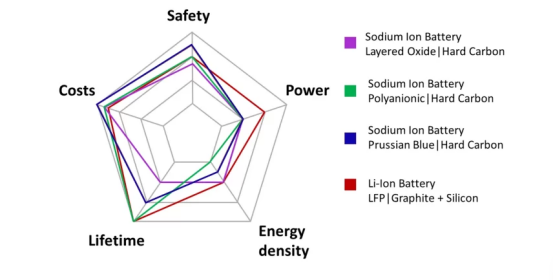
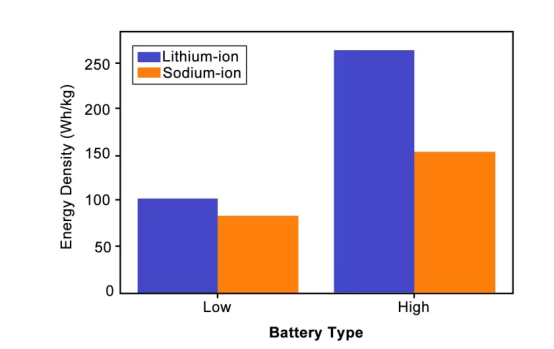
1. Energy Density: Lithium iron phosphate batteries for solar energy storage reach 140–160 Wh/kg, far higher than sodium-ion’s 90–120 Wh/kg; lithium products take less installation space for the same capacity, which is more suitable for residential rooftop PV storage with limited space.
2. Low-temperature Performance: Sodium-ion batteries maintain stable discharge efficiency below -20°C, while lithium-ion capacity decays severely in cold areas, making sodium a better choice for high-latitude outdoor solar energy storage stations.
3. Cycle Life: Lithium batteries support 6000–8000 charge-discharge cycles for household PV storage; mass-produced sodium-ion batteries reach 4000–6000 cycles, sufficient for large industrial peak-shaving projects with frequent daily charging.
2.2 Safety, Raw Material & Cost Difference
---Raw material supply: Lithium relies on scarce lithium ore resources with volatile price fluctuations; sodium uses abundant salt raw materials, with more stable long-term costs.
---Thermal safety: Sodium-ion batteries have no risk of thermal runaway at high temperature, effectively reducing fire hazards of outdoor solar energy storage cabinets; lithium iron phosphate has moderate safety but requires complete BMS thermal management design.
---Unit cost: In 2026, the unit kWh cost of sodium-ion battery is 18% lower than lithium iron phosphate, with larger cost advantages in over 1MWh large-scale solar energy storage projects.
As global distributed solar installation continues to surge in 2026, solar energy storage has become an indispensable core part of residential, commercial and industrial PV systems.
Among multiple battery technologies, lithium-ion batteries dominate most mature PV storage scenarios, sodium-ion batteries are rapidly emerging with unique cost and safety advantages.
3. 2026 Mainstream Battery Solutions for Different Solar Energy Storage Scenarios
Based on global market shipment statistics and installer practical preferences, the mainstream solar energy storage configurations are divided into two categories according to battery types:
3.1 Lithium-ion Battery: Dominant Choice for Residential & Small Commercial PV Storage
Lithium iron phosphate battery remains the absolute mainstream solution for grid-tied residential solar energy storage. Matched with hybrid PV inverters, it supports 24-hour self-power supply, power outage backup and peak-valley electricity arbitrage. The mainstream specifications include 5kWh/10kWh wall-mounted lithium battery packs, perfectly compatible with single-phase residential PV systems below 15kW.
Core strengths: High energy density, compact size, long service life, mature inverter and BMS matching protocols; all mainstream solar inverter brands provide complete supporting programs for lithium storage.
3.2 Sodium-ion Battery: Emerging Scenario-Specific Alternative Technology
For 30MW solar industrial park PV peak shaving, remote island microgrid solar energy storage and northern low-temperature centralized power stations, sodium-ion batteries have become the new mainstream pick in 2026. Manufacturers launch containerized sodium-ion energy storage cabinets with single-unit capacity from 500kWh to 2MWh, cutting total project investment by 12%–15%.
Existing limitations: Low energy density leads to larger cabinet volume; few household inverters support sodium-ion matching, so it is rarely used in small residential rooftop PV systems.
4. Future Development Trends of Solar Energy Storage Battery Technology
Industry professional analysts predict that sodium-ion battery energy density will be upgraded to 130–140Wh/kg by 2028, and its market share in medium & large-scale solar energy storage will rise to 25%.
Lithium-ion batteries will continue to occupy the household distributed storage market relying on its well-developed industrial chain and complete supporting accessories.
5. Conclusion
In summary, the core difference between sodium-ion and lithium-ion solar energy storage batteries lies in technical performance and scenario adaptability rather than market popularity. Currently, lithium-ion batteries maintain absolute mainstream status in the photovoltaic energy storage industry with mature technology, high energy density and strong system compatibility. As an emerging technology, sodium-ion batteries have unique advantages in cost, safety and low-temperature performance, but still need further technical upgrading and industrial improvement to achieve large-scale promotion.
Questions and Answers:
1. Why are sodium-ion batteries frequently compared to lithium iron phosphate (LFP) batteries?
Sodium-ion batteries have a lower energy density than the nickel-based chemistries commonly found in lithium-ion batteries. Consequently, they are better suited for applications with lower energy requirements.
This makes them an ideal choice for stationary energy storage systems and small vehicles where driving range is not a critical factor.
Notably, China’s BYD plans to use sodium-ion batteries in its "micro-cars," clearly indicating the target market segment.
2. Are sodium-ion batteries really cheaper than lithium-ion batteries?
Sodium-ion technology gained significant attention when lithium-ion battery prices spiked due to supply chain disruptions during the COVID-19 pandemic and geopolitical tensions affecting nickel supplies.
However, the situation has evolved; data indicates that lithium-ion batteries will become increasingly affordable over time.
3. Do you recommend sodium-ion battery packs?
It depends on the specific application. Given that costs are currently comparable, we recommend lithium-ion battery packs due to their higher energy density and longer cycle life.
Sodium-ion battery packs, on the other hand, are suitable for applications prioritizing low costs and enhanced safety in cold climates.
We are dedicated to providing customized battery pack solutions to meet your specific needs; please contact us for a professional solution.
1. Football Pitch Lighting Introduction
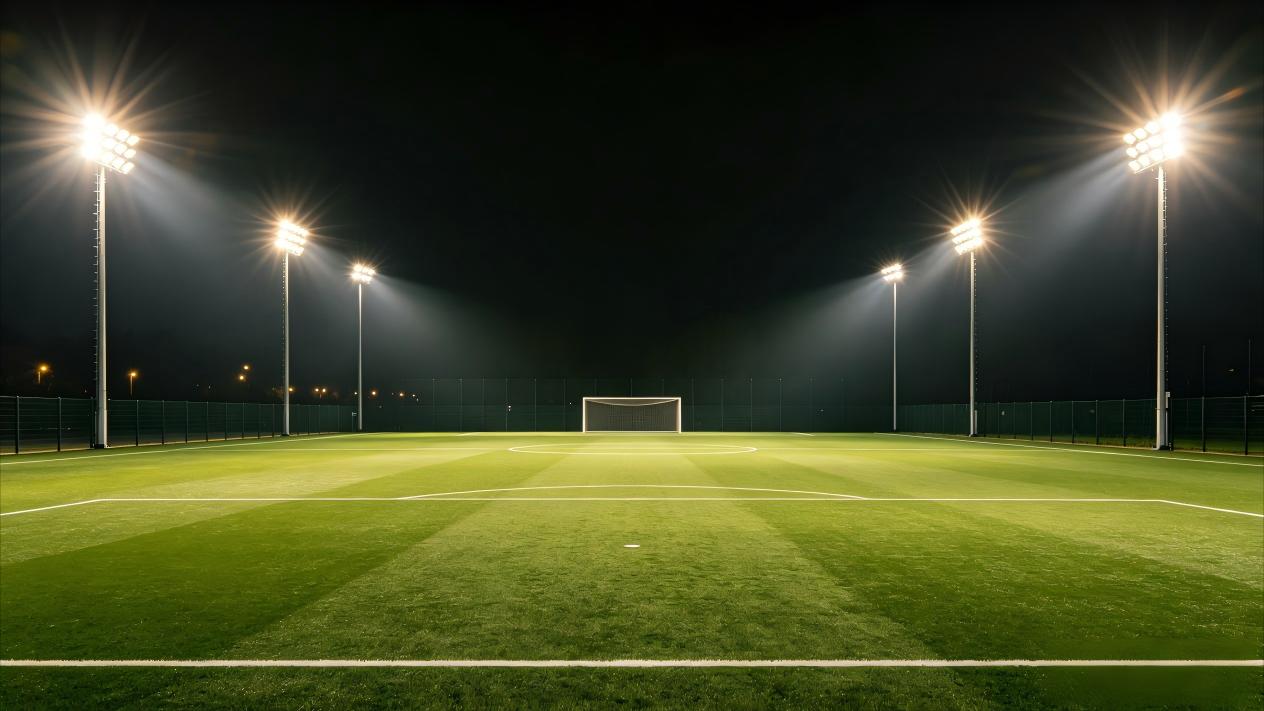
As one of the most essential supporting systems for sports venues, football pitch lighting has stringent professional requirements for illuminance, uniformity, glare control, color rendering, flicker performance and color temperature consistency, which are far higher than ordinary outdoor lighting. Professional stadium lighting meets the demands of night training, daily teaching and amateur matches, and supports professional tournaments, live streaming, as well as 4K/8K ultra-high-definition TV broadcasting.
Developed in accordance with FIFA, UEFA and Chinese national standard JGJ153-2016, HRLUX sports lighting provides customized graded lighting solutions for football pitches of different usage levels. It effectively solves common industry problems including uneven field brightness, dazzling light, screen flickering, color distortion, rapid light attenuation and short service life.
2. HRLUX Football Pitch Lighting Grading Standards
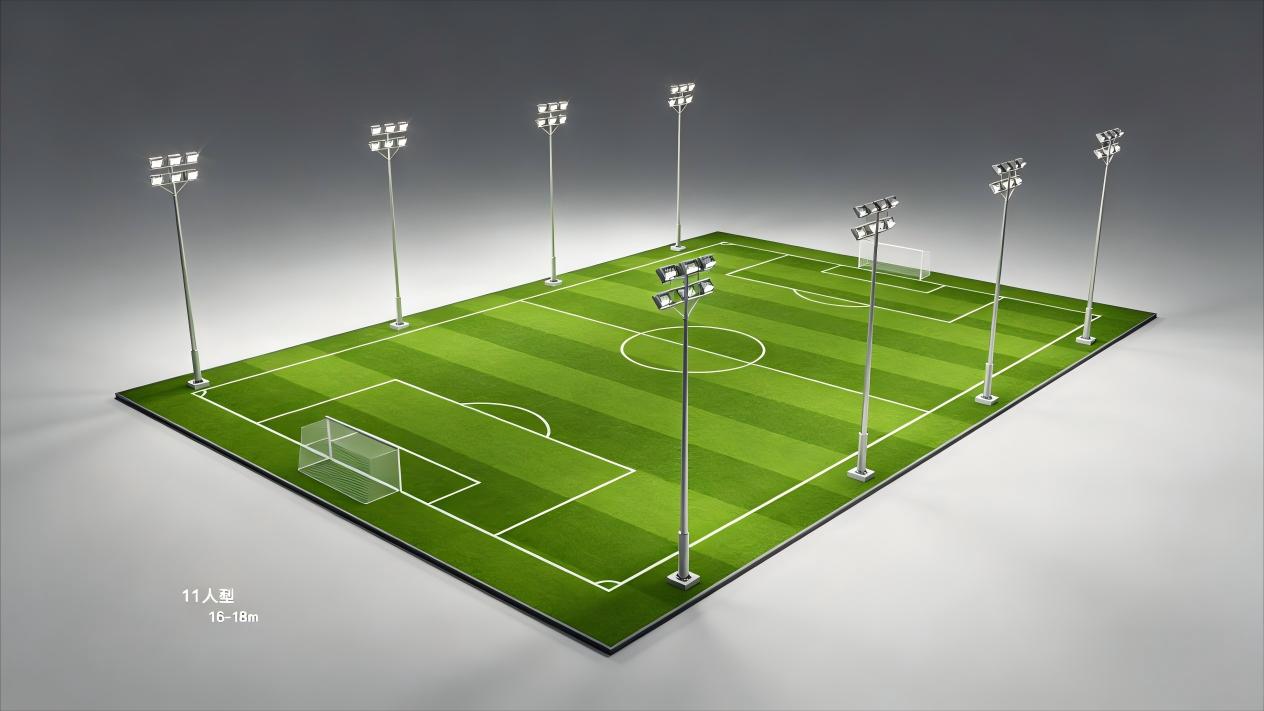
Combining national and international tournament specifications, HRLUX classifies 11-a-side football pitch lighting into five professional grades, covering full application scenarios including community recreation, campus training, professional matches and high-definition broadcasting.
|
Grade |
Application Scenario |
Horizontal Illuminance |
Vertical Illuminance |
Uniformity U2 |
Glare Rating (GR) |
Flicker Depth |
CCT |
CRI |
|
Grade 1 |
Community Recreation & Daily Training |
200lx |
— |
≥0.5 |
≤55 |
≤5% |
4000K |
Ra≥70 |
|
Grade 2 |
Campus Teaching & Amateur Matches |
300–500lx |
— |
≥0.6 |
≤50 |
≤3% |
4500K |
Ra≥80 |
|
Grade 3 |
Professional Training & Municipal Tournaments (Non-broadcast) |
750lx |
750lx |
≥0.7 |
≤47 |
≤2% |
5000K |
Ra≥85 |
|
Grade 4 |
Professional League Matches & HD TV Broadcasting |
1500lx |
1000lx |
≥0.75 |
≤45 |
≤1% |
5500K |
Ra≥90 |
|
Grade 5 |
International Tournaments & 4K/8K Top-level Broadcasting |
2000lx |
1800lx |
≥0.85 |
≤43 |
≤0.5% |
5600K |
Ra≥95 |
3. Standard Football Pitch Dimensions
Standard size of 11-a-side football pitch: 105m × 68m
• Goal size: 7.32m × 2.44m
• Side line buffer zone: ≥1.5m
• End line buffer zone: ≥2m
• Light pole installation position: 3–5m outside side lines, 5–8m outside end lines
4. Lighting Layout & Pole Height Solutions
4-corner Layout (Basic Training Pitch)
Pole height: 15–18m. Designed for Grade 1 training venues. Features low cost and simple installation, fully meeting basic night training requirements.
6-side Layout (Campus & Amateur Pitch)
Pole height: 18–20m. 3 light poles installed symmetrically on both sides. Greatly improves overall lighting uniformity without dark areas, serving as the mainstream solution for campus football pitches.
8-side Layout (Professional Non-broadcast Matches)
Pole height: 20–25m. 4 light poles arranged on each side. Provides sufficient illuminance, superior uniformity and low glare, ideal for municipal and district-level official sports events.
8-pole Hybrid Layout (Corner + Side, Broadcast-level)
Main corner pole height: 25–35m; auxiliary side pole height: 20–25m. Three-dimensional omnidirectional supplementary lighting ensures qualified vertical illuminance, supporting multi-angle camera shooting and high-definition live broadcasting.
5. Core Design Parameter Analysis
Uniformity
Lighting uniformity includes U1 (min/max ratio) and U2 (min/average ratio), the most critical indicators for football field lighting. Poor uniformity causes uneven brightness, athlete visual fatigue and fragmented broadcasting images. With matched multi-beam angles and precise angle projection design, HRLUX achieves a maximum U2 value of 0.85, delivering consistent illumination across the entire pitch with no dark zones or shadow areas.
Glare Control
Excessive glare disturbs athletes’ vision during shooting, heading and running. Equipped with professional shading structures and anti-glare optical lenses, HRLUX lights feature a shading angle above 30° to restrict stray light. The minimum GR value reaches 43 (international ultra-low glare standard), effectively protecting athletes’ eyesight.
Intelligent Dimming System
Supports 0–100% stepless smooth dimming with preset scene modes: training mode, amateur match mode, professional match mode, live broadcast mode and inspection mode. Compatible with mobile control, wall panel control and remote central control, reducing power consumption by up to 40%.
Flicker Control
Ordinary LED lights cause severe flicker, leading to screen ripples, stuttering and ghosting during video shooting. Adopting high-frequency constant current drivers, HRLUX lights achieveflicker depth ≤ 0.5%, fully compliant with slow-motion playback and 4K/8K ultra-HD broadcasting standards.
CCT (Correlated Color Temperature)
Unqualified color temperature causes distorted visual effects. HRLUX adopts standardized color temperature configuration: 4000K for training, 5000K for official matches, 5600K for live broadcasting. With color tolerance ≤ 3SDCM, the pure natural daylight-like light relieves visual fatigue during long-time sports.
CRI (Color Rendering Index)
CRI determines the authenticity of jersey colors, lawn tones and human skin tones. Broadcast-grade HRLUX lights reach Ra≥95 and R9≥80 with excellent red color restoration, presenting vivid jersey details and high-quality broadcasting visuals.
6. 8 Core Advantages of HRLUX Sports Lighting Solutions
Custom Professional Lighting Design
All projects are equipped with official DIALux optical simulation reports. Compatible with 4-pole, 6-pole, 8-pole and roof mast hybrid layouts. We provide one-to-one customized solutions based on venue conditions, budget and tournament levels, avoiding insufficient illumination, over-lighting and light pollution.
High Luminous Efficiency & Energy Saving
The overall luminous efficiency reaches 140–160lm/W. It saves over 70% energy compared with traditional metal halide lamps and 20% compared with ordinary sports LED lights. The light attenuation is extremely low (less than 3% after 5000 working hours) to reduce long-term operation costs.
High-end LED Driver Unit
Adopts industrial-grade constant current drivers with PF≥0.98 and THD<10%. Wide voltage design resists voltage fluctuation, built-in 6KV lightning and surge protection. Stable operation under extreme high and low temperatures with ultra-low failure rate.
Premium Custom Optical Design
Secondary optical lenses and nano reflective structures with optional multi beam angles (10°/25°/40°/60°). Asymmetric light distribution focuses all light on the sports field, eliminating stray light and light pollution while improving overall lighting uniformity.
Superior IP & IK Rating
Featuring IP66 waterproof & dustproof rating and IK08 impact resistance rating. Fully enclosed structure withstands typhoons, heavy rain, snow and impact damage, ensuring stable all-weather outdoor operation.
Laser Precision Positioning Projection
Factory-calibrated laser positioning ensures projection angle deviation less than 0.5°. Accurate light focusing avoids local over-brightness or dim areas for uniform field illumination.
High-efficiency Heat Dissipation System
Integrated die-cast aluminum radiator with three-dimensional convection air duct realizes passive fan-free heat dissipation. Low chip junction temperature prevents heat accumulation, light attenuation and lamp failure, with a service life of up to 100,000 hours.
Ultra-low Glare & Flicker-free Broadcast-grade Quality
Balances athlete visual comfort and professional live broadcast quality. Ideal for campus, enterprise and professional tournament football pitches, complying with both national and international sports lighting certification standards.
7. 11-a-Side Pitch Full Configuration Quick Reference Table
| Grade | Pole Height | Pole Quantity | Single Lamp Power | Total Power | Layout Method |
| Training Grade | 15–18m | 6 | 400W | 9.6–14.4kW | 6 Side Poles |
| Amateur Grade | 18–20m | 6 | 500–600W | 18–28.8kW | 6 Side Poles |
| Professional Grade | 25m | 4 | 800–1000W | 25.6–48kW | 4 Corner Poles |
| Broadcast Grade | 25–35m | 8 | 1000–1500W | 50–70kW | Corner & Side Hybrid Layout |
Related Products
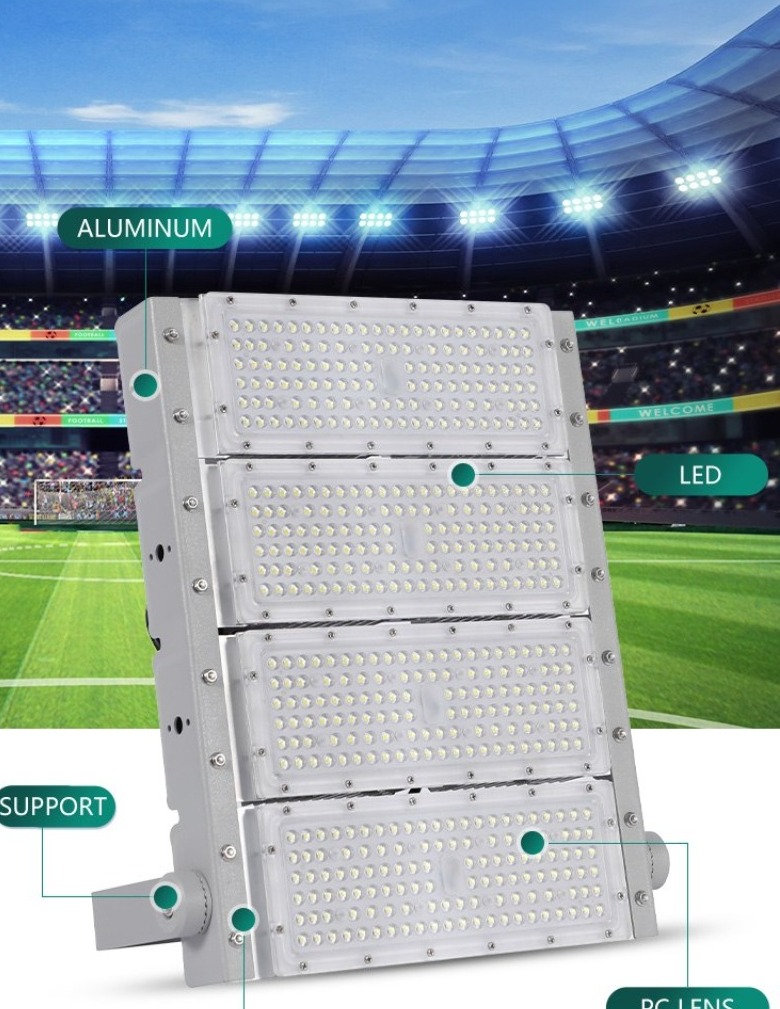
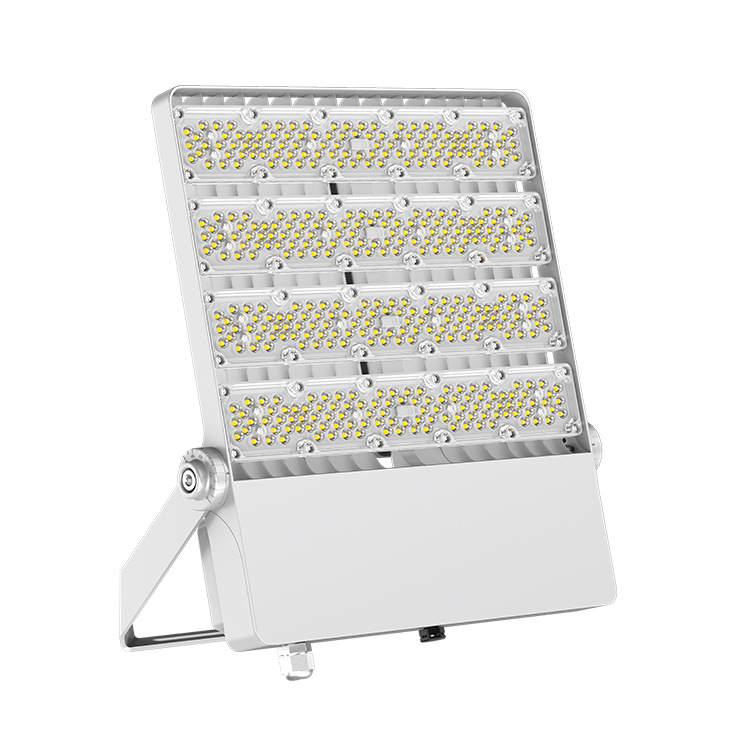
Neptune Series 200W-600W High Power Outdoor LED Flood Light
Your Reliable Outdoor Lighting Partner
HRLUXSOLAR focuses on mid-to-high-end outdoor lighting with strict quality standards and a rigorous, responsible team. We take quality as the core and professionalism as the foundation to provide stable and durable outdoor lighting products.We specialize in professional services for municipal and commercial engineering projects, delivering customized lighting solutions for smooth project implementation. We support flexible customization, efficient delivery and full-process technical support to meet diverse project demands.Committed to being your trusted outdoor lighting partner, HRLUXSOLAR keeps improving to create better lighting value for your projects.
Need a Dialux simulation for your project? Click here for a free lighting plan.
Introduction
Sports enthusiasts and venue managers constantly struggle with various court lighting issues. Uncontrolled strong light leads to harsh dazzling glare, uneven brightness disrupts athletes’ judgment of ball tracks, and fixed luminosity also creates unnecessary power waste. These prevalent drawbacks greatly degrade sports experience and cut down venue operational profits.
This article thoroughly introduces the 220V anti-glare LED lamp designed for padel and pickleball courts, released by HRLuxSolar. Equipped with customized P50 optical lens and adjustable 0-10V dimming module, this professional sports lighting fixture targets common outdoor stadium lighting defects. It effectively resolves glare disturbance, inconsistent brightness and rigid light adjustment troubles, emerging as a mainstream option for newly-built and renovated padel and pickleball sports venues.
Why Glare Hinders Court Sports Experience
A standard padel court covers an area of 10 meters by 20 meters, surrounded by fully enclosed tempered glass barriers. Conventional wide-angle LED lamps scatter light randomly, and massive light rays bounce back from glass surfaces to form intense glare. While executing overhead lobs and rapid hitting moves, players fail to identify ball flight paths clearly. Poor visibility not only undermines competitive performance, but also causes eye strain after prolonged physical activities.
Relevant specifications issued by International Padel Federation and CIE 121:2019 set clear requirements. Professional competition venues are demanded to keep unified glare rating below 19. Qualified stadium lighting products focus on precise light control, rather than simply pursuing high power output.
P50 Asymmetric Lens: Core Anti-Glare Optical Structure
The outstanding lighting performance of this padel and pickleball LED lamp stems from tailor-made P50 lens structure, optimized exclusively for glass-enclosed sports court surroundings.
- The 40°×130° asymmetrical beam concentrates light onto court ground, minimizing stray light reflection on glass fences
- Light transmittance reaches over 92%, maximizing effective luminous utilization and reducing light energy loss
- Built-in anti-reflective coating restrains inner light reflection, with actual UGR controlled under 18, exceeding common industrial benchmarks
- Overall field uniformity stays above 0.8, eliminating dim corners and bright spots to fit fast multi-directional hitting sports
Ordinary floodlights register UGR between 25 and 30 with uniformity merely 0.5 to 0.6. In contrast, P50 lens cuts glare impact by over 60% and lifts light uniformity by 30%. Athletes can maintain clear sight during casual matches and long-duration team training sessions.
0-10V Stepless Dimming: Adaptive Brightness for Diversified Scenarios
Different occasions require distinct light intensity. Casual recreation demands mild brightness, formal tournaments need high-standard illumination, and live streaming puts forward stricter requirements on light stability. The 0-10V dimming system supports smooth brightness adjustment ranging from 10% to 100% without flickering phenomena.
- 0V corresponds to power-off status, facilitating daily power management
- 5V stands for 50% luminosity, with 300-500 lux suitable for casual games and routine training
- 10V delivers full power brightness, offering 750-1000 lux to meet official contest and live broadcast criteria
Compared with traditional dimming modes, 0-10V adjustment possesses remarkable strengths. Flicker-free light source ensures crisp shooting footage without shadow distortion. The system maintains stable signal transmission within 50 meters, free from external electromagnetic interference. It also boasts wide compatibility with most mainstream commercial lighting control systems available on the market.
220V Power Input & Robust Build: Adapt to Severe Outdoor Conditions
Designed to match global civilian power standards, the 220V AC input allows direct connection to municipal power grids. No extra transformer installation is required, simplifying on-site wiring construction procedures.
The whole fixture achieves IP66 dustproof and waterproof level, functioning steadily amid temperatures ranging from -30℃ to 50℃ against rain, snow, wind and sand erosion. Integrated high-purity aluminum heat radiator accelerates heat dissipation and slows down light decay speed. The service lifespan extends to 50,000 hours. Calculated on 5-hour daily operation, the lamp can work reliably for 10 to 15 years, drastically lowering later-stage venue maintenance expenses.
Practical Installation Parameters & Scene Matching Advice
The ideal mounting height for P50 lens stadium lamps ranges from 6 to 8 meters, with single lamp covering 20 to 25 square meters. Four to six lamps are sufficient to offer full-range illumination for standard padel courts. Three power ratings including 200W, 300W and 400W are optional, catering to private backyard courts, club training grounds and professional competition arenas. 5000K neutral white light restores original ball color and enhances visual recognition effect.
Target Users & Purchasing Guidance
- Private courtyard court builders for family daily sports entertainment
- Padel and pickleball club operators to raise member satisfaction level
- Public sports facility administrators to satisfy daily opening and group activity needs
- Tournament organizers and content creators supporting high-level match recording
FAQ
Q1:Is this lamp applicable to glass fenced pickleball courts?
A:bsolutely yes. The P50 lens effectively reduces reflective glare from glass surfaces.
Q2:Will 0-10V dimming influence live video recording results?
A:Zero-flicker design guarantees sharp and steady live streaming visuals.
Q3.What quantity of lamps fits a standard competition court?
A:Four to six units of 300W lamps can satisfy professional lighting demands.
Related Products
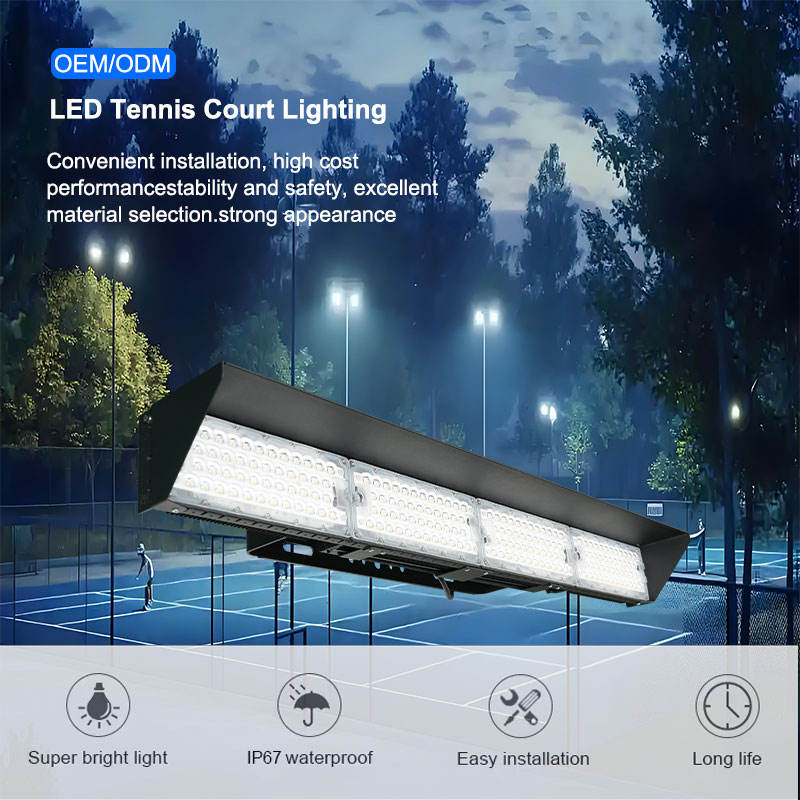
220V Anti Glare Padel Pickleball LED Light | P50 Lens With 0-10V Dimmable Option
Related Cases
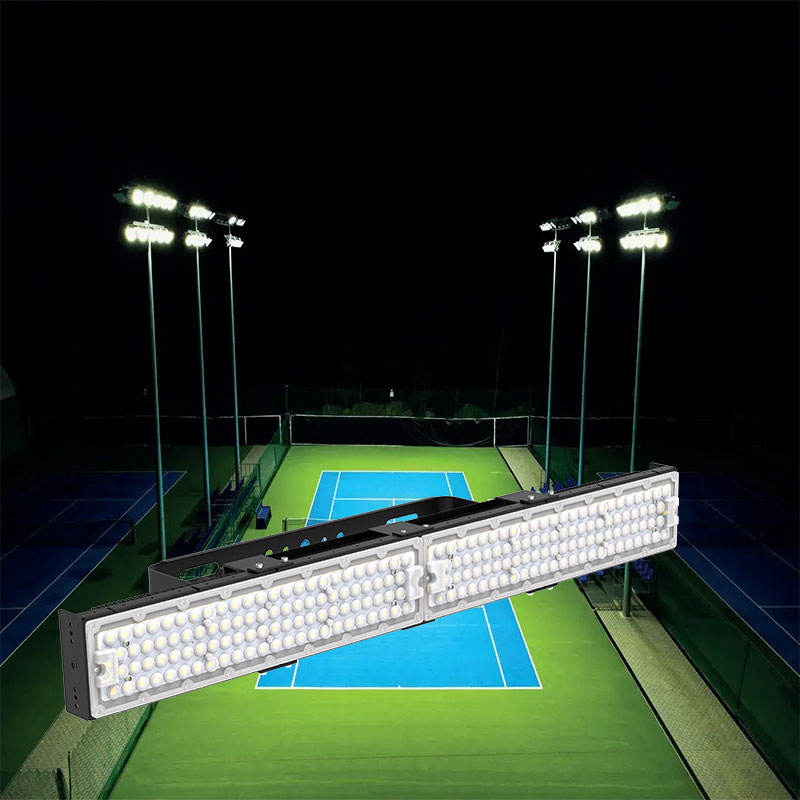
PadelBox Bermondsey Indoor Padel Court Lighting Case Study
Your Reliable Outdoor Lighting Partner
HRLUXSOLAR focuses on mid-to-high-end outdoor lighting with strict quality standards and a rigorous, responsible team. We take quality as the core and professionalism as the foundation to provide stable and durable outdoor lighting products.We specialize in professional services for municipal and commercial engineering projects, delivering customized lighting solutions for smooth project implementation. We support flexible customization, efficient delivery and full-process technical support to meet diverse project demands.Committed to being your trusted outdoor lighting partner, HRLUXSOLAR keeps improving to create better lighting value for your projects.
Need a Dialux simulation for your project? Click here for a free lighting plan.
Introduction
Professional football pitch lighting is never a simple lamp installation project. Unreasonable pole layout, mismatched beam angles, and improper lamp power will lead to uneven brightness, severe glare, insufficient vertical illuminance, and failed broadcasting qualification. To avoid on-site rework, extra costs and unqualified project delivery, professional lighting manufacturers rely on DIALux evo simulation for full-scene photometric analysis before construction.
As a core tool compliant with FIFA, UEFA and international CIE standards, DIALux enables accurate 3D modeling, illuminance calculation, glare simulation and scheme optimization. All HRLUX football stadium lighting projects adopt official DIALux simulation verification, ensuring every finished venue fully meets tournament and broadcast-grade requirements.
What Is DIALux Lighting Simulation?
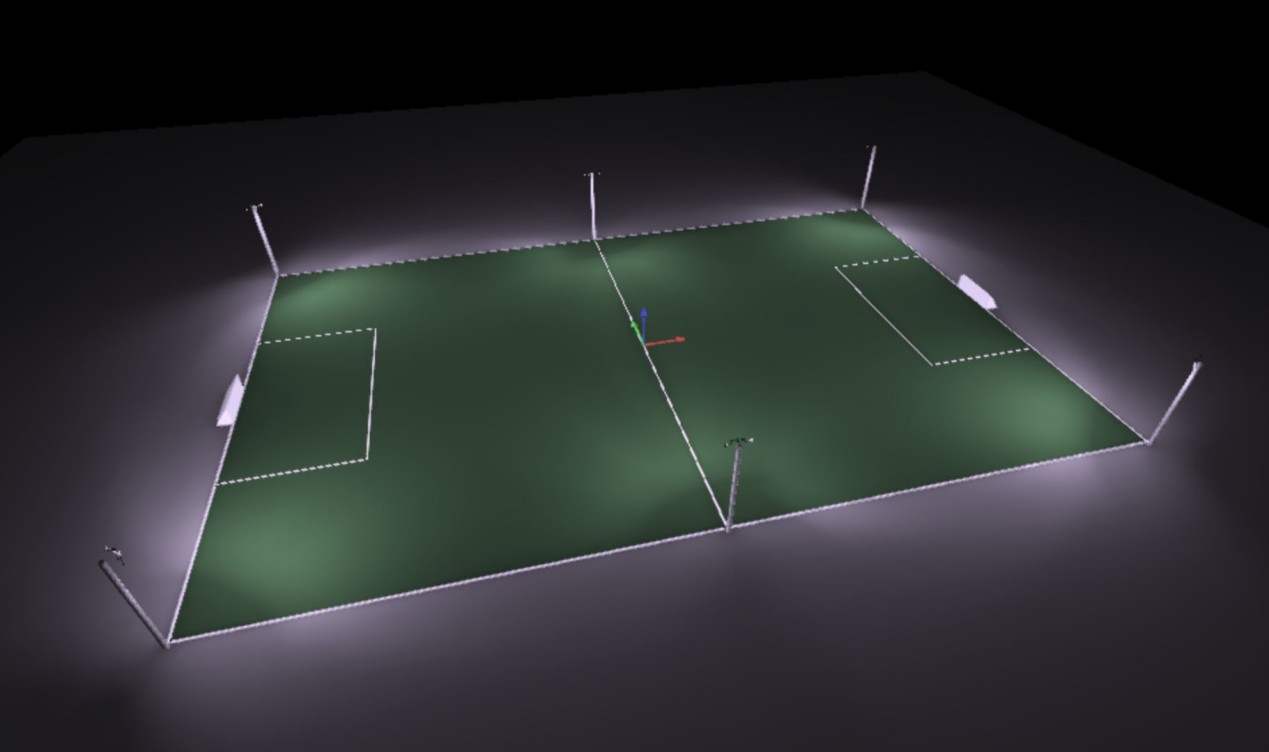
DIALux is a globally authoritative and free professional lighting design software, widely adopted in outdoor sports venues, stadiums, squares and architectural lighting projects. It imports authentic lamp IES photometric files to simulate real luminous performance, including horizontal/vertical illuminance, uniformity, glare rating (GR), flicker performance and light pollution data.
Different from empirical manual design, DIALux simulation turns subjective lighting design into data-driven standardized engineering, eliminating design errors and ensuring 100% compliance with international sports lighting specifications.
Core Applications of DIALux Simulation in Football Pitch Lighting
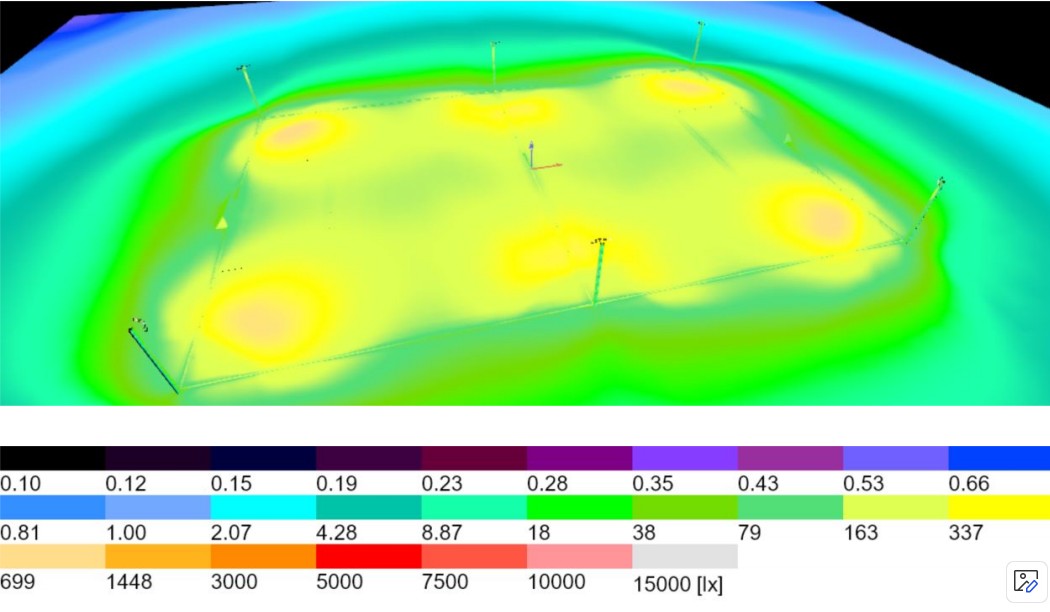
1.Scientific Layout & Pole Parameter Optimization
Different pitch sizes (5-a-side, 7-a-side, 11-a-side) and competition grades require differentiated pole heights, quantities and spacing. DIALux builds 1:1 venue 3D models to test multiple layout solutions, including 4-corner layout, 6-side layout, 8-side layout and roof canopy mounting.
Engineers can adjust pole height (15m–35m), installation distance, lamp tilt angle and spacing in the software to avoid central dark zones or over-bright edges. It effectively solves common on-site problems such as poor overall uniformity and inconsistent brightness between penalty area and midfield.
2.Accurate Illuminance & Uniformity Verification
Illuminance and uniformity are the two core indicators of football field lighting quality. DIALux precisely calculates average horizontal illuminance, vertical illuminance, minimum/maximum illuminance, and uniformity U1/U2 values.
HRLUX leverages DIALux simulation to match corresponding parameters for different grades:
•Training Grade: Ensure average illuminance ≥200lx, U2 ≥0.5
•Amateur Grade: Ensure average illuminance 300–500lx, U2 ≥0.6
•Professional Grade: Ensure average illuminance ≥750lx, U2 ≥0.7
•Broadcast Grade: Ensure vertical illuminance 1000–2000lx, U2 ≥0.75–0.85
All simulation data is recorded in official export reports, supporting project inspection, bidding and customer qualification verification.
3.Professional Glare & Light Pollution Control
Excessive glare seriously affects athletes’ visual judgment and match fairness, while stray light causes light disturbance to surrounding residential areas. DIALux can simulate professional GR glare rating and stray light distribution.
By adjusting lamp aiming angles, selecting matched beam angles and optimizing anti-glare optical structures, HRLUX optimizes GR value between 43–50. It effectively suppresses overflow light, complies with CIE 150:2017 light pollution standards, and makes sports venues more community-friendly.
4.Broadcast-Grade Flicker & Color Parameter Calibration
For HD and 4K/8K live broadcast venues, flicker and color consistency are indispensable indicators. Combined with professional driver parameters and lamp CCT/CRI data, DIALux verifies overall field lighting stability, ensuring flicker depth ≤0.5%, color tolerance ≤3SDCM, Ra ≥90–95 and R9 ≥80.
This professional calibration guarantees stable, high-restoration visual effects for commercial live streaming and slow-motion playback.
5.Energy-Saving Scheme Verification & Cost Control
Blindly increasing lamp power will lead to excessive energy consumption and unnecessary budget waste. DIALux compares multiple schemes with different lamp power and quantities to find the most cost-effective configuration.
In multiple football field renovation projects, HRLUX uses DIALux simulation to replace traditional high-power metal halide lamps with low-power high-efficiency LED lights, achieving 40%–70% power saving while meeting FIFA standard parameters, greatly reducing long-term operational costs for venue owners.
6.Standardized Project Report Output
DIALux can export formal PDF simulation reports containing 3D venue models, layout diagrams, illuminance contour maps, parameter test data and overall evaluation results. As official technical documents, these reports support global project bidding, engineering acceptance and after-sales technical verification.
HRLUX Professional DIALux Simulation Service Advantages
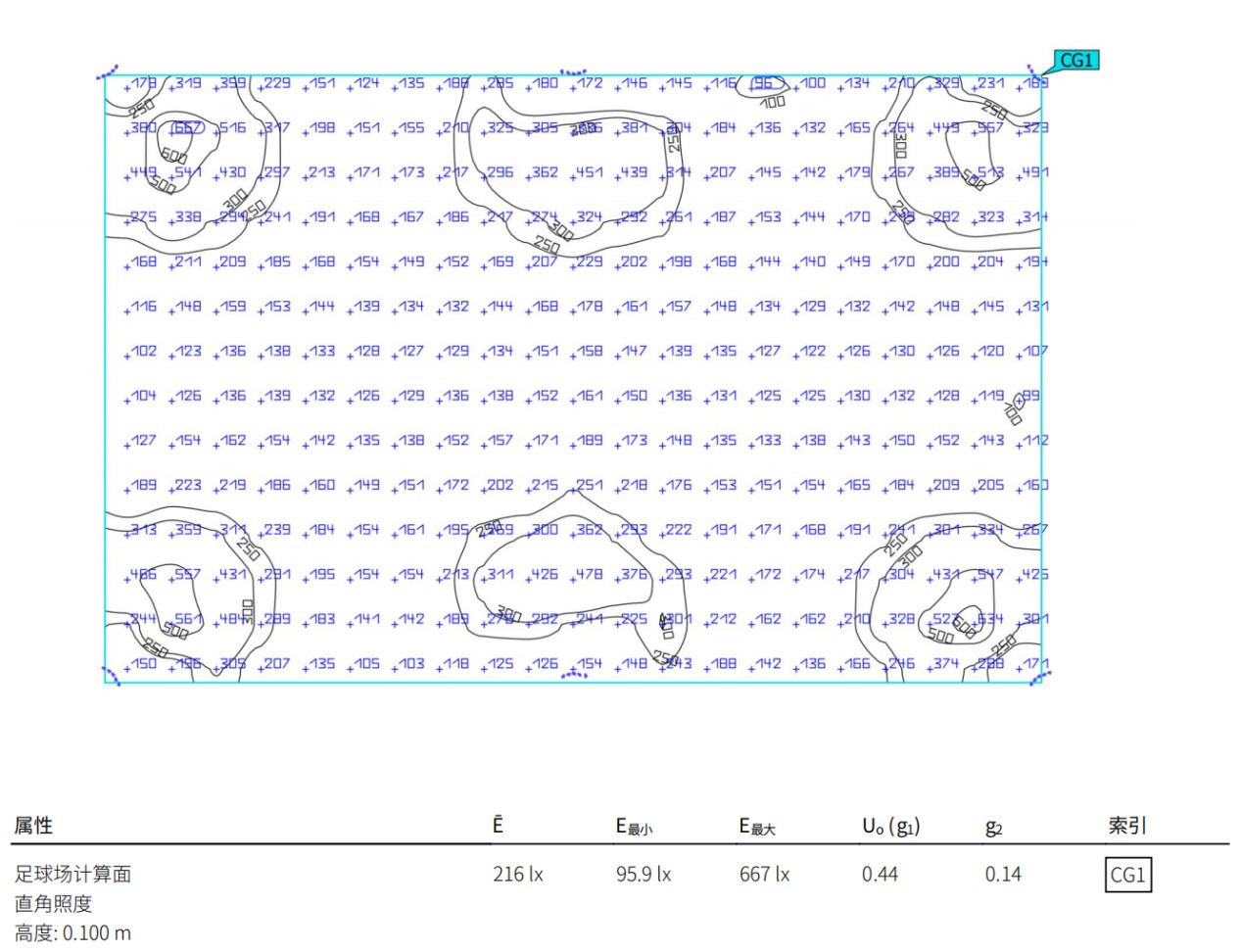
Different from suppliers providing fixed generic schemes, HRLUX delivers one-to-one customized DIALux simulation design for every football lighting project:
•Import authentic IES files of HRLUX sports lights to ensure simulated data consistent with real on-site effects
•Adapt to 5-a-side, 7-a-side, 11-a-side and customized irregular football venues
•Optimize schemes for community training, campus amateur, professional competition and top broadcast-level scenarios
•Provide complete official simulation reports for global bidding and engineering acceptance
•Avoid on-site dark areas, glare, unqualified uniformity and repeated construction
Conclusion
DIALux illuminance simulation is the core prerequisite for standardized, professional and reliable football pitch LED lighting design. It standardizes the entire design process from layout planning, parameter optimization to effect verification, avoiding empirical design defects and project risks.
With professional DIALux simulation technology and mature sports lighting solutions, HRLUX helps global sports venue owners obtain compliant, energy-saving, low-maintenance and broadcast-ready football field lighting systems.
Related Products
Your Reliable Outdoor Lighting Partner
HRLUXSOLAR focuses on mid-to-high-end outdoor lighting with strict quality standards and a rigorous, responsible team. We take quality as the core and professionalism as the foundation to provide stable and durable outdoor lighting products.We specialize in professional services for municipal and commercial engineering projects, delivering customized lighting solutions for smooth project implementation. We support flexible customization, efficient delivery and full-process technical support to meet diverse project demands.Committed to being your trusted outdoor lighting partner, HRLUXSOLAR keeps improving to create better lighting value for your projects.
Need a Dialux simulation for your project? Click here for a free lighting plan.
1. What Is Professional Football Field Lighting?
Football field lighting is a specialized LED floodlight system designed to deliver consistent, safe, and high-performance illumination for training sessions, amateur matches, professional games, and live TV broadcasts. With scientific pole arrangement and premium optical design, modern football lighting achieves high illuminance, superior uniformity, low glare, ultra-low stroboscopic flicker, and accurate color rendering.
A qualified sports lighting solution ensures clear sightlines for players, fair judgment for referees, high-definition broadcast footage, and comfortable viewing experiences for spectators. Meanwhile, it balances energy saving, weather resistance, and intelligent control for long-term venue operation.
2. FIFA-Grade Football Lighting Grading Standards
In accordance with FIFA, UEFA, and international sports lighting regulations, HRLUX divides football field lighting into five clear grades. Each grade matches specific application scenarios with fixed technical parameters. This standardized classification helps engineers and project contractors select the most cost-effective lighting configuration.
All data below is compliant with international sports lighting standards.
| Grade | Applicable Scenarios | Horizontal Illuminance Eh (lx) | Vertical Illuminance Ev (lx) | Uniformity U1 (U2) | Glare GR | Stroboscopic Ratio | Color Temperature CCT (K) | Color Rendering Index CRI (Ra) |
| Grade I | Training / Community Venues | 200–300 | — | ≥0.4(0.5) | ≤55 | ≤5% | 4000–4500 | ≥70 |
| Grade II | Amateur / Campus Venues | 500–750 | — | ≥0.5(0.6) | ≤50 | ≤3% | 4500–5000 | ≥80 |
| Grade III | Professional Non-broadcast Matches | 1000–1500 | ≥750 | ≥0.6(0.7) | ≤47 | ≤2% | 5000–5500 | ≥85 |
| Grade IV | TV Broadcast Matches | ≥1500 | ≥1000 | ≥0.7(0.75) | ≤45 | ≤1% | 5500–5600 | ≥90 |
| Grade V | Top-tier 4K/8K Broadcast Matches | ≥2000 | ≥1800 | ≥0.75(0.85) | ≤43 | ≤0.5% | 5600 | ≥95(R9≥80) |
3. Standard Football Field Design Procedures
To build a compliant football pitch, lighting designers must follow standardized design steps to avoid dark zones, strong glare, or uneven brightness.
1. Confirm venue grade: Select reasonable illuminance, uniformity, and glare standards based on actual usage.
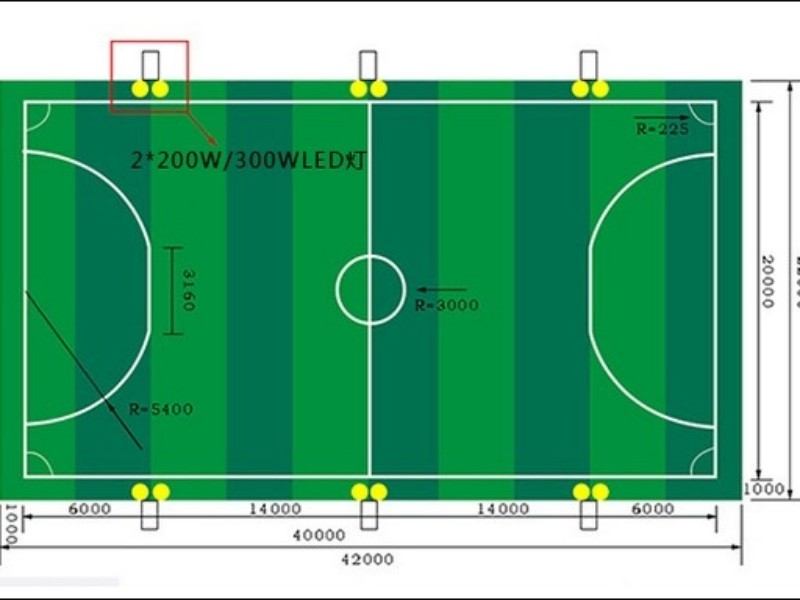
2. Clarify pitch dimensions: 11-a-side (105×68m), 7-a-side (60×40m), 5-a-side (40×20m).
3. Determine pole layout: 4 poles for training, 6 poles for amateur, 8 poles for professional venues.
4. Match lamp parameters: Power from 400W to 1500W; beam angle 10°–60°; luminous efficacy ≥130lm/W.
5. Simulation testing: Use DIALux or AGi32 to verify all lighting indicators before construction.
6. Install intelligent systems: Support dimming, scene switching, emergency mode, and remote control.
4. Official 11-A-Side Football Pitch Dimensions
The 11-a-side football field is the most common standard venue for professional and commercial projects.
- Pitch size: 105m × 68m
- Goal size: 7.32m × 2.44m
- Buffer zone: ≥1.5m (touchlines); ≥2m (goal lines)
- Pole installation distance: 3–5m from touchlines; 5–8m from goal lines
5. Three Mainstream Football Lighting Layout Modes
5.1 Four-Corner Layout (4 Poles)
Best for: Community fields, training grounds, small pitches.
Four poles are installed at four corners with a height of 15–18m. This layout is cost-effective and easy to install, though uniformity is moderate with minor dark areas.
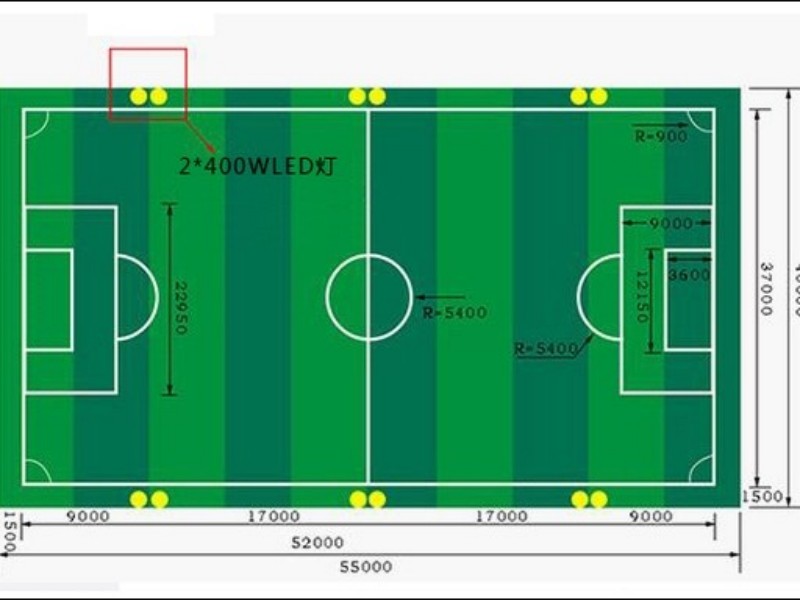
5.2 Bilateral Symmetrical Layout (6/8 Poles)
Best for: Amateur fields, campus stadiums, non-broadcast professional pitches.
Evenly place 3–4 poles on each side at a height of 18–25m. This layout delivers excellent uniformity, low glare, and no obvious dark zones.
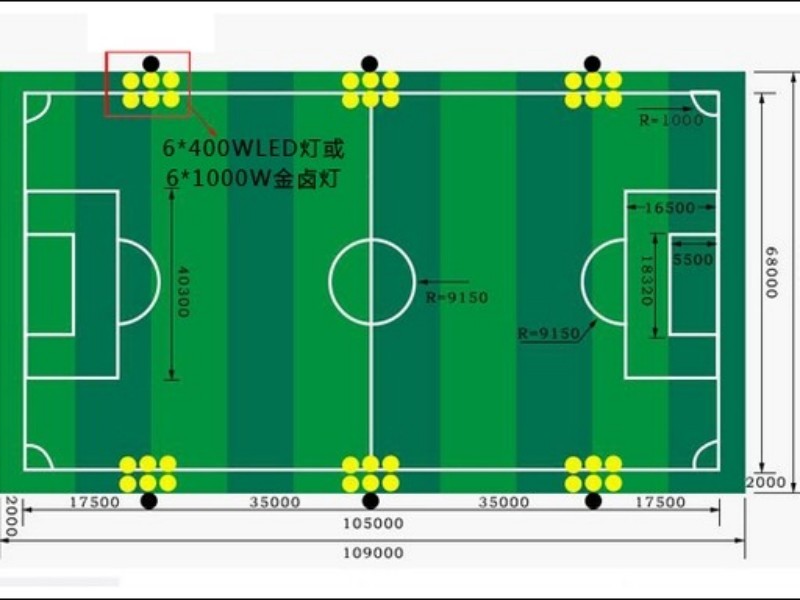
5.3 Four-Corner + Catwalk Hybrid Layout
Best for: Top-tier stadiums, 4K/8K live broadcast venues.
Combined with 8 ground poles and roof catwalk supplementary lights (25–35m height). It achieves ultra-even illuminance, ultra-low glare, and fully meets high-definition broadcasting standards.
6. Lamp Pole Layout & Height Core Parameters
6.1 Layout Spacing
- Training venues: 25–30m pole spacing
- Amateur venues: 20–25m pole spacing
- Broadcast venues: 15–20m pole spacing
6.2 Pole Height Standards
- Training: 15–18m (projection angle ≥20°)
- Amateur: 18–20m (glare reduction)
- Professional: 25m (meet vertical illuminance demand)
- Broadcast: 25–35m (FIFA angle: 25°–45°)
6.3 Installation Requirements
- Minimum 3m distance between poles and touchlines
- Foundation bearing capacity ≥1.5 times the total lamp weight
- Installation angle: 25°–35° to avoid direct dazzling light
7. Lighting Uniformity (Most Critical Indicator)
Uniformity determines whether the entire pitch has consistent brightness without flickering dark spots.
- U1 (Min/Max): Training ≥0.4 | Amateur ≥0.5 | Professional ≥0.6 | Broadcast ≥0.75
- U2 (Min/Average): Training ≥0.5 | Amateur ≥0.6 | Professional ≥0.7 | Broadcast ≥0.85
Optimization methods: Increase pole quantity, raise height, and mix narrow & medium beam angles.
8. Glare Control for Football Stadiums
Glare Rating (GR) directly affects athlete comfort and viewing experience.
- Ordinary fields: GR ≤50
- Broadcast fields: GR ≤45
- Top-tier stadiums: GR ≤43
Anti-glare solutions: Install anti-glare hoods, keep shading angle ≥30°, adopt asymmetric optical design, and avoid unilateral strong light.
9. Intelligent Dimming Lighting System
Modern football floodlights support multi-scene intelligent dimming to reduce unnecessary power consumption.
- Training mode: 30% brightness
- Match mode: 70% brightness
- Broadcast mode: 100% brightness
- Emergency mode: 50% brightness
Control methods include touch panels, mobile APP, and remote centralized control. Intelligent dimming saves 30%–50% energy annually.
10. Stroboscopic Flicker Suppression
Severe stroboscopic flicker causes eye fatigue and distorted slow-motion footage. HRLUX adopts high-frequency PWM dimming and flicker-free chips to control flicker depth below 0.5%.
11. Color Temperature (CCT) Selection
- Community fields: 4000–4500K (soft white)
- Campus fields: 4500–5000K (neutral white)
- Professional stadiums: 5500–5600K (natural daylight)
Color tolerance ≤3SDCM to ensure zero color deviation during live broadcasting.
12. Color Rendering Index (CRI)
High CRI ensures real color restoration for jerseys, grass, and human skin tones.
- Basic training: Ra ≥70
- Amateur matches: Ra ≥80
- Professional games: Ra ≥85
- 4K broadcast: Ra ≥95 & R9 ≥80
13. Why Choose HRLUX Football Lighting Solutions?
13.1 Customized FIFA Standard Design
HRLUX provides free DIALux lighting simulation for every project. We customize beam angles (10°–60°), power, CCT, and CRI to match all venue grades.
13.2 Ultra-High Luminous Efficacy 140–160lm/W
Compared with traditional metal halide lamps, our LED floodlights save 60%–80% electricity. With only ≤3% light attenuation in 5,000 hours, the service life reaches 100,000 hours.
13.3 Industrial-Grade Driving System
Equipped with Infineon and Mitsubishi chips, the lamps support AC90–305V wide voltage and 6KV lightning protection. The power factor reaches 0.98 with ultra-low harmonic distortion.
13.4 Professional Asymmetric Optical Design
Nano reflective cups and secondary lenses improve uniformity by 20%. The 30° shading angle keeps GR below 43 without dazzling glare.
13.5 IP66 & IK08 Heavy-Duty Protection
Die-cast aluminum housing ensures dustproof, waterproof, and impact-resistant performance. It works stably from -40℃ to 85℃ in extreme weather.
13.6 Laser Positioning Focusing Technology
Light projection deviation is controlled within 0.5°, effectively reducing light pollution and improving field light concentration.
13.7 Efficient Fan-Free Heat Dissipation
Integrated heat sink expands heat dissipation area by 40°. The silent fan-free design realizes maintenance-free long-term operation.
14. Get Free Football Field Lighting Design
Whether you are building a community training pitch, campus football field, or professional broadcast stadium, HRLUX provides one-stop sports lighting solutions.
✅ Free DIALux illumination simulation
✅ Custom pole layout solution
✅ 5-year official warranty
✅ 24/7 professional engineering support
Contact HRLUX team now to get a personalized football field lighting design and quotation.
Related Products
Your Reliable Outdoor Lighting Partner
HRLUXSOLAR focuses on mid-to-high-end outdoor lighting with strict quality standards and a rigorous, responsible team. We take quality as the core and professionalism as the foundation to provide stable and durable outdoor lighting products.We specialize in professional services for municipal and commercial engineering projects, delivering customized lighting solutions for smooth project implementation. We support flexible customization, efficient delivery and full-process technical support to meet diverse project demands.Committed to being your trusted outdoor lighting partner, HRLUXSOLAR keeps improving to create better lighting value for your projects.
Need a Dialux simulation for your project? Click here for a free lighting plan.
In recent years, more and more municipal and rural projects choose solar street lights instead of traditional grid-connected street lights, and the core reason is cost saving—both short-term construction cost and long-term operation cost can be significantly reduced. First, save construction cost: Solar street lights do not need to lay cables, dig trenches or connect to the power grid, which saves a lot of labor and material costs. For remote rural areas without a complete power grid, solar street lights can be installed directly, avoiding the high cost of power grid reconstruction. Second, save operation cost: Solar street lights rely on sunlight for power supply, realizing zero electricity cost all year round. Compared with traditional street lights, which need to pay high electricity bills every month, solar street lights can save tens of thousands of dollars in electricity costs every year for large-scale projects. Third, reduce maintenance cost: High-quality solar street lights (such as HRLUX Sirius series) have a long service life and low failure rate. The integrated design and strict quality control reduce the frequency of maintenance and replacement, further saving long-term maintenance costs. HRLUX provides one-stop solution for municipal and rural solar lighting projects, from scheme design to product delivery, helping you reduce project costs and improve project value.
Introduction
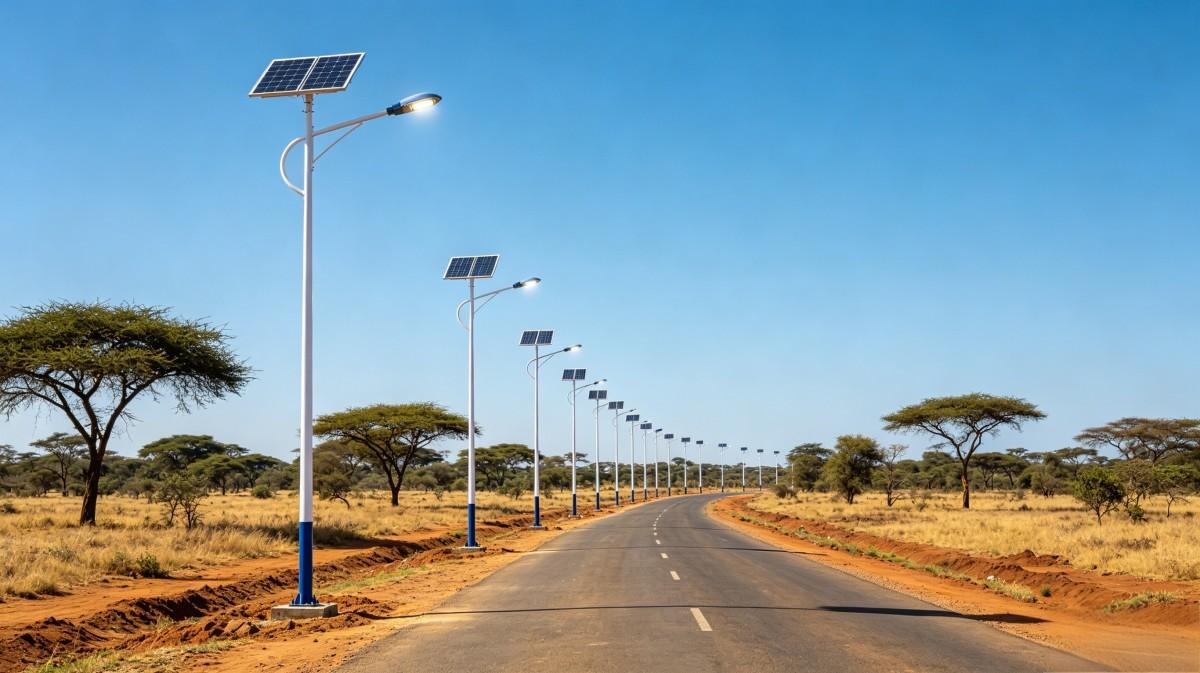
Most rural areas across Africa suffer from unstable or zero grid power access, making solar street lights the most cost-effective, long-term lighting solution for village roads, school perimeters, rural market squares, residential compounds and remote community passages. However, most project contractors and government procurement teams face a common dilemma: cheap generic solar street lights fail massively within 1–2 years after installation.
Typical failures include rapid battery decay under extreme tropical heat, dust-blocked solar panels with low power generation, water ingress and short circuits during long rainy seasons, frequent blackouts on cloudy days, and deformed brackets blown down by tropical strong winds. Unlike Southeast Asian coastal humid environments, African rural areas have unique harsh conditions including ultra-high temperature, seasonal sand dust, severe thunderstorms, poor transportation and lack of professional maintenance conditions.
Based on hundreds of successful rural lighting projects in Nigeria, Kenya, Ghana, Tanzania and Uganda, this 2026 ultimate buying guide summarizes region-based selection standards, anti-theft solutions, full-cycle cost analysis and professional Dialux lighting parameters to help global project buyers choose durable, low-maintenance and high-qualified solar street lights that can run stably for 8–10 years, avoiding project rework and failed official acceptance.
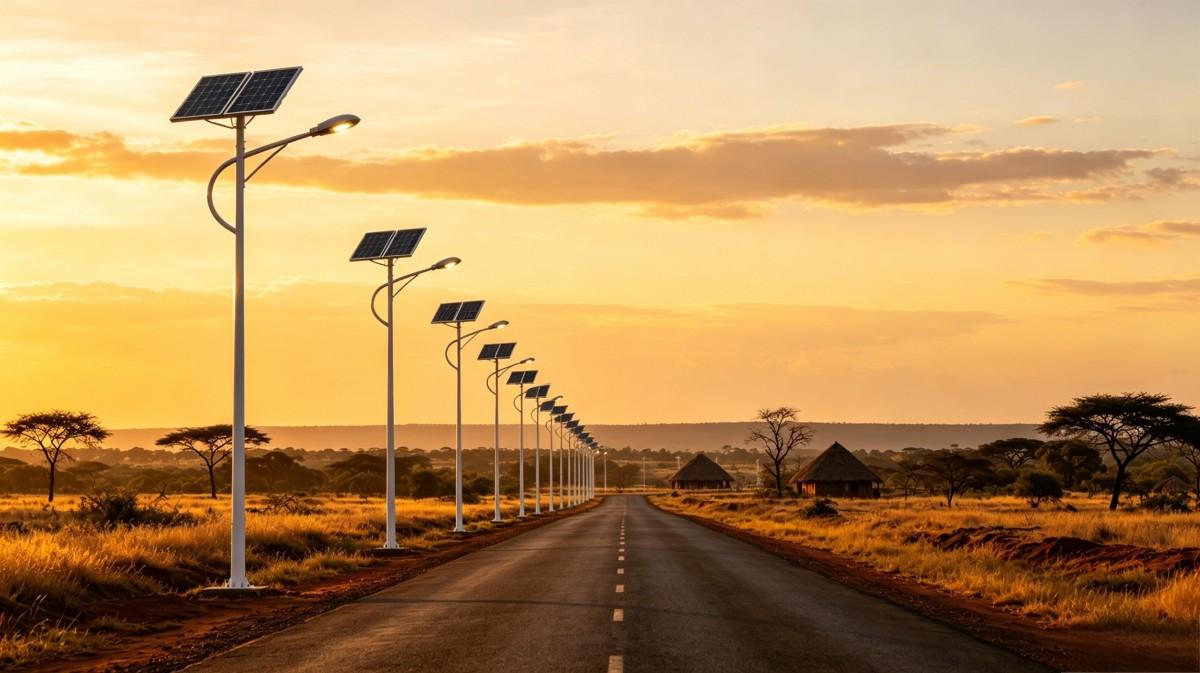
1. Unique Environmental Challenges in African Rural Areas (Regional Classification)
Africa’s climate varies greatly in different regions. A unified standard cannot fit all rural projects. We classify the core challenges of West Africa, East Africa and Southern Africa to achieve targeted selection:
1.1 West Africa (Nigeria, Ghana, Senegal) — High Temperature & Severe Sand Dust
West Africa features long dry seasons with daytime temperatures reaching 40°C–52°C, accompanied by frequent sand dust and dry wind. Ordinary batteries suffer severe thermal attenuation, and unprotected solar panels are easily covered by thick dust, resulting in 40%–60% power generation loss.
1.2 East Africa (Kenya, Tanzania, Uganda) — Long Rainy Seasons & Frequent Thunderstorms
East Africa has concentrated and prolonged rainy seasons, with frequent lightning strikes and sudden torrential rains. Low IP-rated lamps are prone to water penetration and circuit burnout; unprotected lamps will be damaged in batches during thunderstorm seasons.
1.3 Southern Africa (Mozambique, Zambia) — Humid & Windy Coastal & Plateau Areas
Southern Africa has high air humidity and strong plateau gusts, requiring higher anti-corrosion and wind resistance performance for lamp structures.
1.4 Universal Rural Pain Points Across Africa
•No grid backup: Remote villages have no emergency power supply, requiring sufficient rainy-day backup capacity.
•Rough transportation & simple installation: Bumpy rural roads cause collision damage; local construction teams lack professional installation tools.
•Serious lamp theft risk: Scattered rural settlements lack monitoring, making lamp theft a common problem.
•Extremely difficult after-sales maintenance: Spare parts are hard to purchase locally, requiring lamps with low failure rate and ultra-low maintenance.
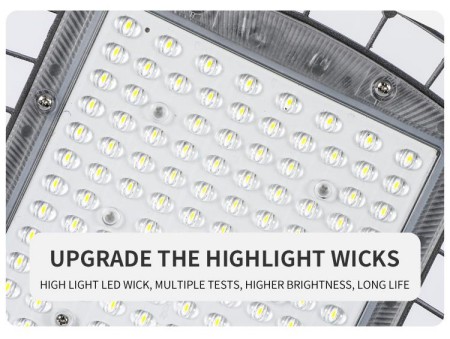
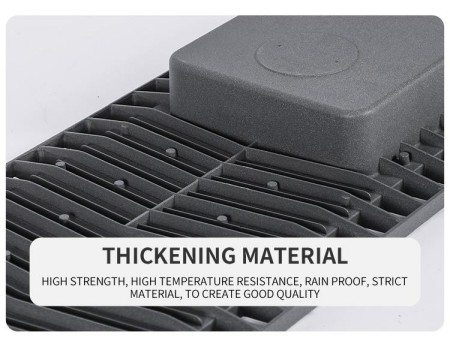
2. Solar Street Light Type Selection: All-in-One vs Split Type for African Rural Areas
Most buyers are confused about choosing integrated or split solar street lights for African villages. Combined with local usage habits and environment, we give clear selection suggestions:
2.1 All-in-One Solar Street Light (Highly Recommended for African Rural)
The integrated design integrates solar panel, battery, LED light source and controller into one unit. It is the most suitable type for current African rural projects.
•Anti-theft advantage: No external exposed solar panels and separate batteries, effectively avoiding component theft, solving the biggest hidden danger of rural project loss.
•Simple installation: One-person quick installation, no complex wiring, adapting to unprofessional local construction conditions.
•Good sealing performance: Integral die-casting structure, better dustproof and waterproof effect than split lamps, suitable for dusty and rainy African environments.
2.2 Split Solar Street Light (Only for Individual Large Highway Projects)
Split lamps have large solar panels and separate batteries, with higher power generation. However, exposed parts are easy to be stolen, and wiring is complicated. It is not recommended for conventional village road and community lighting projects.
3. Six Mandatory Configuration Standards for African Rural Solar Street Lights
3.1 High Temperature Resistant LiFePO4 Battery (Core Necessity)
Ordinary ternary lithium batteries fail rapidly above 40°C and cannot adapt to West Africa’s ultra-high temperature environment. All qualified solar street lights for African rural projects must adoptwide-temperature LiFePO4 batteries with an operating range of -30°C to 65°C.
•More than 5000 charge-discharge cycles, long service life
•Built-in overheating, overcharge, overdischarge and short-circuit multiple protection
•Fully sealed battery compartment to prevent dust and rain erosion
3.2 High-Efficiency Monocrystalline Solar Panel with Automatic Dust Removal Design
Aiming at African dust accumulation problems, customized panels adopt 22% high conversion rate monocrystalline silicon, with inclined border design. Light rain can automatically wash away surface dust, maintaining long-term high power generation efficiency.
3.3 IP66 Full Sealed Dustproof & Waterproof Structure
IP65 lamps are easy to seep water in long rainy seasons. IP66 full sealed structure with silicone rubber gaskets for all joints and reserved internal drainage grooves, which can effectively resist heavy rain infiltration and tropical high humidity corrosion.
3.4 Independent 10kV Lightning Protection Module
East African rainy seasons are accompanied by frequent lightning strikes. Built-in independent surge protection module can resist 10kV lightning surge, avoiding batch burnout of controllers and batteries.
3.5 Thickened Wind & Vibration Resistant Bracket
2.0mm thick die-cast aluminum bracket, anti-deformation and anti-loose. The 15°–30° adjustable installation angle matches Africa’s low latitude sunlight angle, adapting to tropical strong gusts and bumpy transportation.
3.6 Intelligent MPPT Dimming Controller
Compared with low-efficiency PWM controllers, MPPT maximum power tracking technology improves power utilization rate by 25%. It supports multiple intelligent modes: human body induction dimming, timing dimming, full brightness mode, meeting the energy-saving and safety needs of rural villages.
4. Professional Parameter Comparison & Full-Cycle Cost ROI Analysis
4.1 Technical Parameter Comparison
| Performance Item | Ordinary Low-Cost Solar Street Light | HRLUX Custom Africa Rural Solar Light |
| Battery Working Temperature | Max 40℃, easy decay | -30℃~65℃ high-temp resistance |
| Solar Panel Efficiency | 16% polycrystalline | ≥22% monocrystalline high efficiency |
| Waterproof & Dust Grade | IP65 semi-sealed | IP66 full sealed |
| Controller | PWM low efficiency | Intelligent MPPT + lightning protection |
| Wind Resistance | Grade 8 ordinary wind | Grade 10 tropical strong wind |
| Rainy Day Backup | 1–2 days (easy blackout) | 4–6 days stable lighting |
| Service Life | 3–4 years | 8–10 years |
4.2 8-Year Full-Cycle Cost ROI Comparison (Core Reference for Government & NGO Projects)
| Cost Item (8 Years) | Low-Cost Ordinary Lights | HRLUX Custom Durable Lights |
| Initial procurement cost | Low | Slightly higher |
| Mid-term replacement & maintenance cost | High (replace 2–3 times) | Almost zero maintenance |
| Project rework & acceptance risk loss | High | Zero risk |
| Comprehensive 8-year cost | 30%–40% higher | Cost-effective & stable |
Low-priced lights seem to save initial budget, but frequent failures, replacement and rework will cause huge hidden costs and even lead to project failure. Customized durable solar lights are the most cost-effective choice for long-term rural public infrastructure projects.
5. Dialux Verified Lighting Parameters for Different African Rural Scenarios
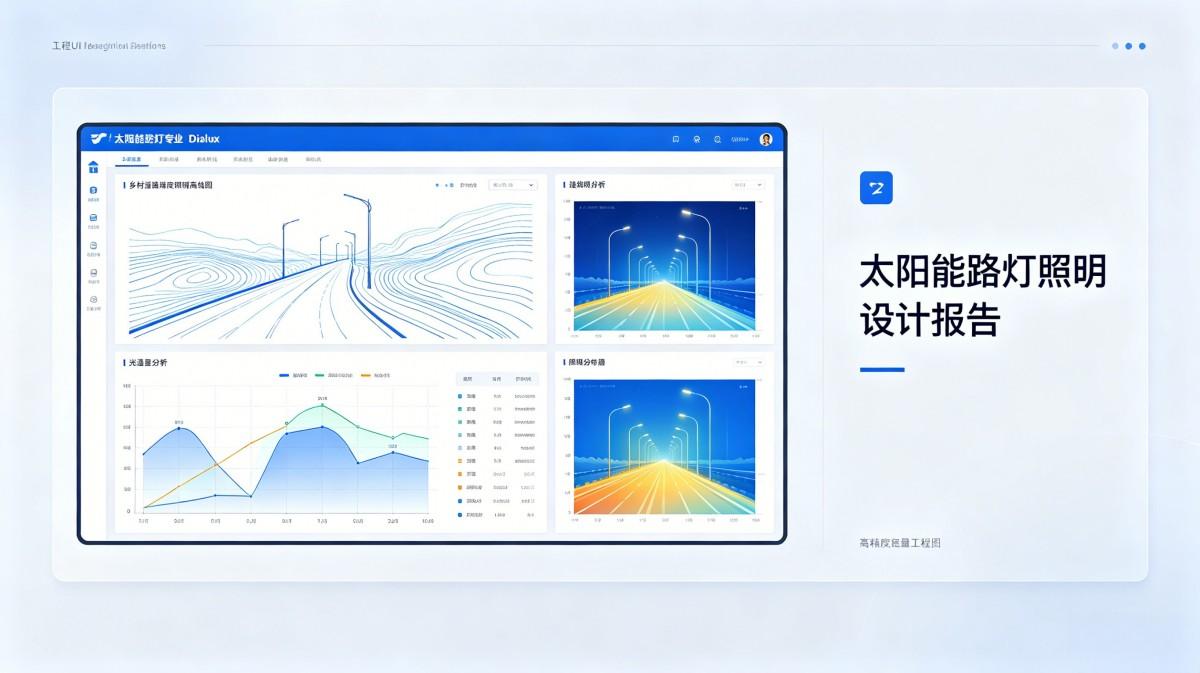
All installation heights, pole spacing and illumination standards are simulated and verified by Dialux professional lighting software, fully complying with African rural road lighting acceptance standards:
All installation heights, pole spacing and illumination standards are simulated and verified by Dialux professional lighting software, fully complying with African rural road lighting acceptance standards:
•Rural footpaths & residential alleys (30W–40W): Installation height 4–5m, pole spacing 18–22m, average illumination ≥12lux, optional human induction mode for energy saving
•Village main roads & market surrounding roads (60W–80W): Installation height 6–7m, pole spacing 22–28m, average illumination ≥28lux, stable constant brightness mode
•School & hospital perimeter, town square (100W–120W): Installation height 7–8m, average illumination ≥35lux, full-night lighting for public safety
6. Real Project Case: 450 Sets Solar Street Light Project in Kisumu, Kenya
A rural village reconstruction project in Kisumu, Kenya covers scattered rural lanes, primary school perimeters and central market areas. Facing local high temperature, frequent thunderstorms and certain theft risks, the project team finally selected 450 sets of HRLUX anti-theft high-temperature resistant all-in-one solar street lights.
A rural village reconstruction project in Kisumu, Kenya covers scattered rural lanes, primary school perimeters and central market areas. Facing local high temperature, frequent thunderstorms and certain theft risks, the project team finally selected 450 sets of HRLUX anti-theft high-temperature resistant all-in-one solar street lights.
Project Configuration: High-temp LiFePO4 battery, IP66 fully sealed housing, MPPT intelligent controller, built-in lightning protection, anti-theft integrated structure
Project Operation Effect: After 3.5 years of stable field operation, no battery swelling, no water ingress failure, no theft loss, and normal lighting throughout the 4-month long rainy season. The project successfully passed local government official acceptance, completely solving the problem of no lighting in rural villages and replacing traditional expensive kerosene lamps.
7. FAQ
Q1: Can cheap generic solar street lights be used for African rural government projects?
A: Not recommended at all. Low-cost lamps lack high-temperature resistance, lightning protection and dustproof design. Most of them fail on a large scale within 1–2 years, resulting in project rework, increased hidden costs and failed official acceptance.
Q2: Why are all-in-one solar lights more suitable for African rural areas than split lights?
A: Integrated lights have no exposed external components, effectively solving rural theft problems. Meanwhile, they support quick installation without complex wiring, adapting to local simple construction conditions, and have better overall sealing for dust and rain prevention.
Q3: How many consecutive rainy days should African rural solar lights support?
A: It must support 4–6 days of continuous rainy and cloudy lighting to adapt to the long seasonal rainy weather in East and West Africa.
Q4: Is LiFePO4 battery necessary for African tropical lighting projects?
A: Yes. Ordinary ternary lithium batteries decay rapidly above 40°C and cannot survive long-term high-temperature exposure. LiFePO4 battery is the only stable energy storage solution for African tropical rural areas.
Q5: How to solve the theft problem of solar street lights in African villages?
A: Prioritize all-in-one integrated solar street lights with no exposed parts. Equip with anti-loose stainless steel screws and customized installation locks to maximize anti-theft performance.
Q6: Can you provide customized Dialux simulation reports and OEM batch services?
A: HRLUX supports full OEM/ODM customization. We can provide exclusive Dialux illumination layout schemes, power matching and customized packaging solutions according to local latitude, climate and project scale, and support one-stop export and customs clearance services.
Q7: What is the maintenance cycle for African rural solar street lights?
A: Ultra-low maintenance design. Only simple cleaning of solar panel surface dust every 2–3 months is required, no professional maintenance and spare parts replacement are needed in the short term.
Related Products
Related Cases
Your Reliable Outdoor Lighting Partner
HRLUXSOLAR focuses on mid-to-high-end outdoor lighting with strict quality standards and a rigorous, responsible team. We take quality as the core and professionalism as the foundation to provide stable and durable outdoor lighting products.We specialize in professional services for municipal and commercial engineering projects, delivering customized lighting solutions for smooth project implementation. We support flexible customization, efficient delivery and full-process technical support to meet diverse project demands.Committed to being your trusted outdoor lighting partner, HRLUXSOLAR keeps improving to create better lighting value for your projects.
Need a Dialux simulation for your project? Click here for a free lighting plan.
Introduction
A large number of engineering contractors hold a wrong mindset that solar street lights require zero maintenance. Is this viewpoint reliable? Definitely not. Ignoring routine inspections will result in frequent light flickering, insufficient luminous flux and mass lamp breakdowns, which bring substantial compensation losses to construction teams.
Daily operation and maintenance expenses directly decide project profit margins and satisfaction levels of end clients. With standardized, low-cost and regular upkeep work, operators can prolong the whole service cycle of solar street lights by 2 to 3 years. Relevant field data proves that standardized maintenance can lift panel power output by 18%-25%, and slash the expenditure on battery replacement by over 30% for a lighting project equipped with 500 lamp units.
The professional technical team of HRLUX has sorted out three budget-friendly and easy-to-implement maintenance schemes, tailored for dusty, humid construction environments across Africa, Southeast Asia and mining zones. All maintenance procedures don’t demand professional testing devices or experienced electricians, perfectly matching the operation demands of municipal road, village and mining lighting projects.
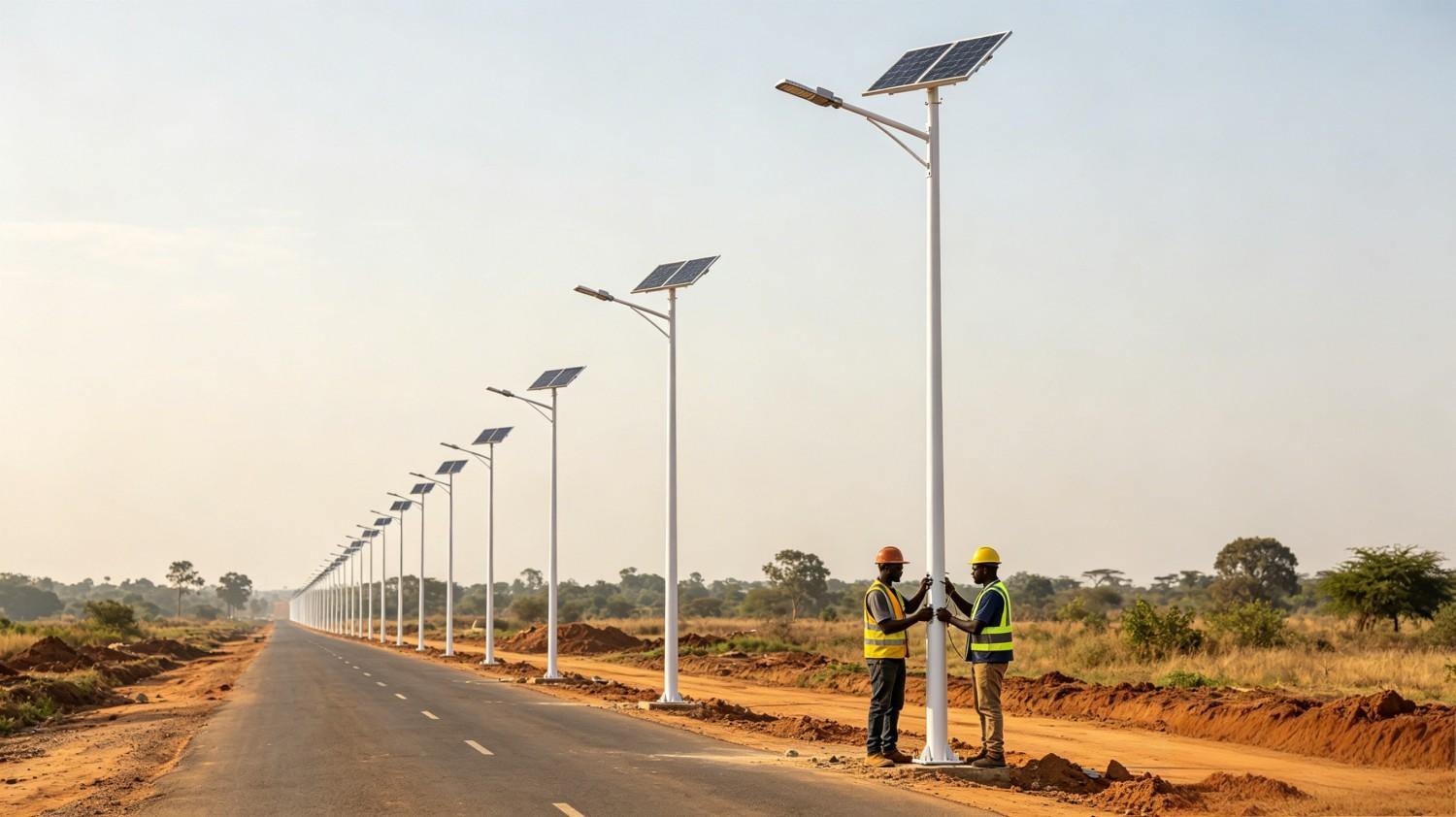
1. Regular Solar Panel Cleaning
Solar panels serve as the core power generation component of the entire solar street light system. In windy, dusty and rainy regions, mud, bird droppings and fallen dry leaves keep covering the tempered glass surface, blocking sunlight absorption and causing obvious decline of charging efficiency.
Maintenance Cycle & Standard Operation Guide
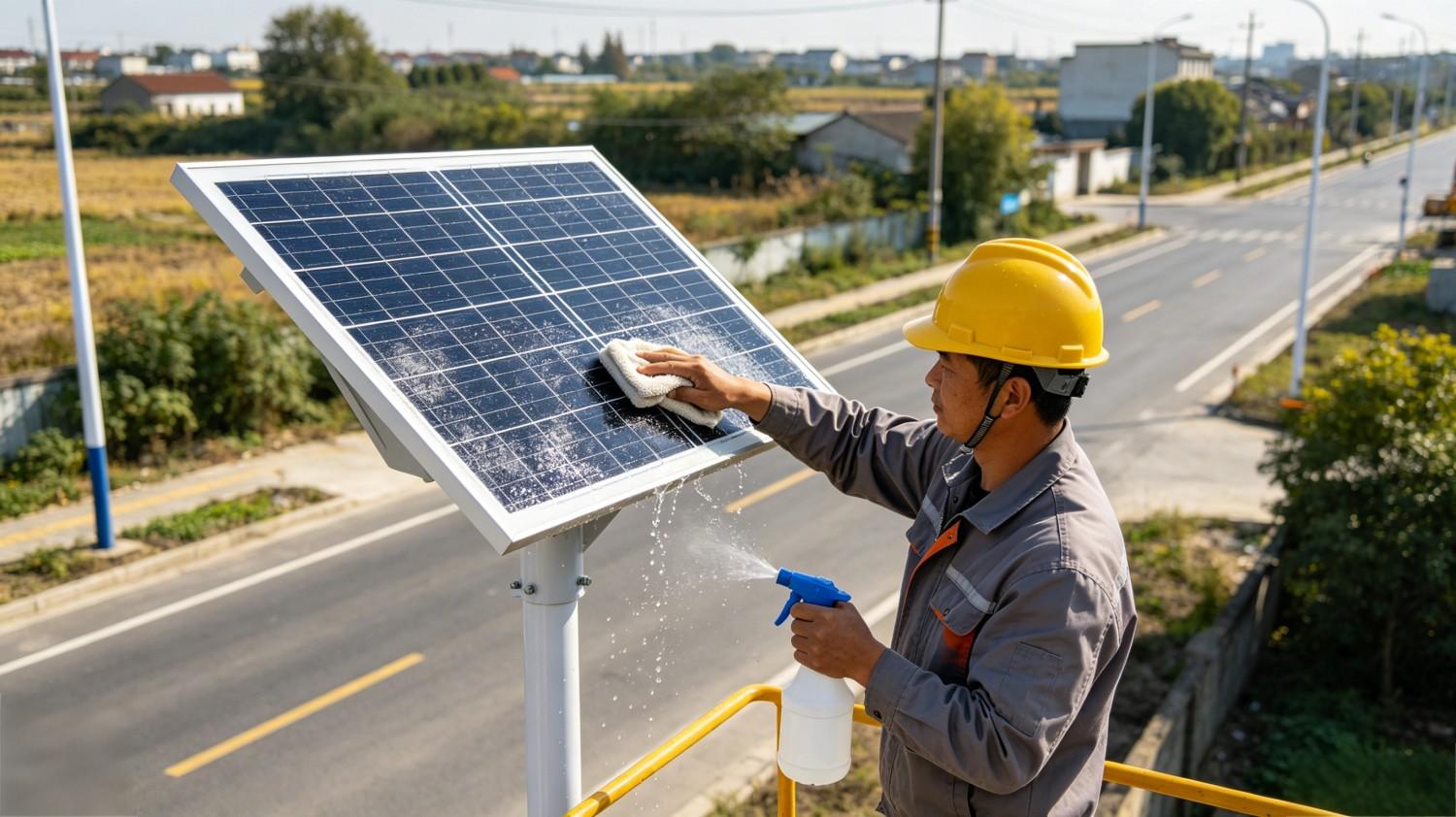
Recommended cleaning frequency: Conduct cleaning once every 3 months for ordinary municipal roads; shorten the cycle to once per month for mining areas and sand roads with heavy dust accumulation.
Safe operation steps: Flush the panel surface with clean tap water at first, then wipe stubborn stains with soft cotton cloth. Abrasive hard brushes and corrosive chemical detergents are forbidden, as scratches left on tempered glass will trigger irreversible loss of power generation capacity.
Low-cost optimization suggestion: Apply a thin layer of anti-dust coating once every year for long-term protection; this low-price consumable costs less than $0.5 for each single lamp.
2. Semi-Annual Battery Terminal Inspection & Anti-Corrosion Treatment
Lithium storage batteries control the continuous lighting duration of solar street lamps. Loose cables and oxidized terminals rank as the top hidden faults during long-term outdoor running. Poor electric contact leads to unstable power supply, dim light output or complete lamp blackout overnight.
Maintenance Cycle & Standard Operation Guide
Inspection frequency: Finish comprehensive circuit examination once every half year.
Troubleshooting steps:
1.Fasten all loose cable connectors to eliminate hidden dangers of poor contact;
2.Erase white and green oxidized corrosives on terminals with dry cloth, and spray anti-rust agent after cleaning for lasting protection.
Core advantage: This inspection procedure creates zero labor and material costs, which effectively avoids mass lamp malfunctions induced by circuit defects.
3. Waterproof Sealing Inspection Within 24 Hours After Heavy Rain
Severe thunderstorms and humid tropical climates bring rigorous tests to the waterproof performance of outdoor solar street lamps. Water permeation inside lamp housings or wiring junction boxes directly results in circuit short circuits and burnt-out control drivers and batteries. Waterproof inspection is compulsory right after heavy rainstorms.
Maintenance Cycle & Standard Operation Guide
Inspection timing: Complete full waterproof inspection within 24 hours after heavy thunderstorms.
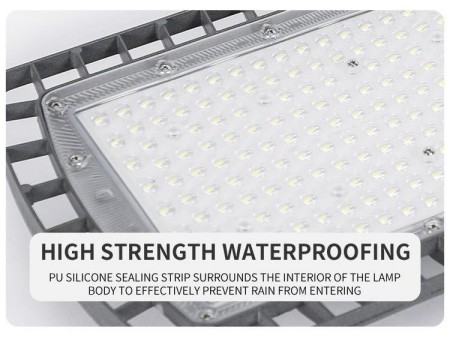
Key inspection positions: Lamp outer shell, inner lamp cavity, wiring junction box and silicone sealing strips.
Solution for seepage failures: Once operators spot water accumulation, cracked sealing strips or gap seepage, contact the lamp manufacturer immediately to replace accessories and prevent secondary damage to internal electronic components.
HRLUX Sirius series solar street lights adopt factory-built fully integrated all-around waterproof construction. The optimized sealing structure largely lowers the probability of water seepage faults and reduces long-term maintenance workload for engineering contractors.
Supplementary Section: Low-Budget Consumables for Long-Term Lamp Protection
If your lighting project demands stable operation for 3–5 years and reduces frequent manual maintenance visits, prepare these cheap auxiliary consumables with extremely low total investment:
1.Anti-rust terminal spray: Stop oxidation of battery connectors, cost-efficient for large-scale engineering projects
2.Transparent anti-dust coating: Extend the cleaning interval of solar panels, suitable for mining zones and desert highway lighting projects
3.Silicone repair glue: Temporarily fix cracked sealing strips to handle sudden water seepage emergenciesAll three types of supplies carry low unit prices and can cut annual maintenance labor hours by over 40%.
Appendix: Solar Street Light Quick Fault Check Table
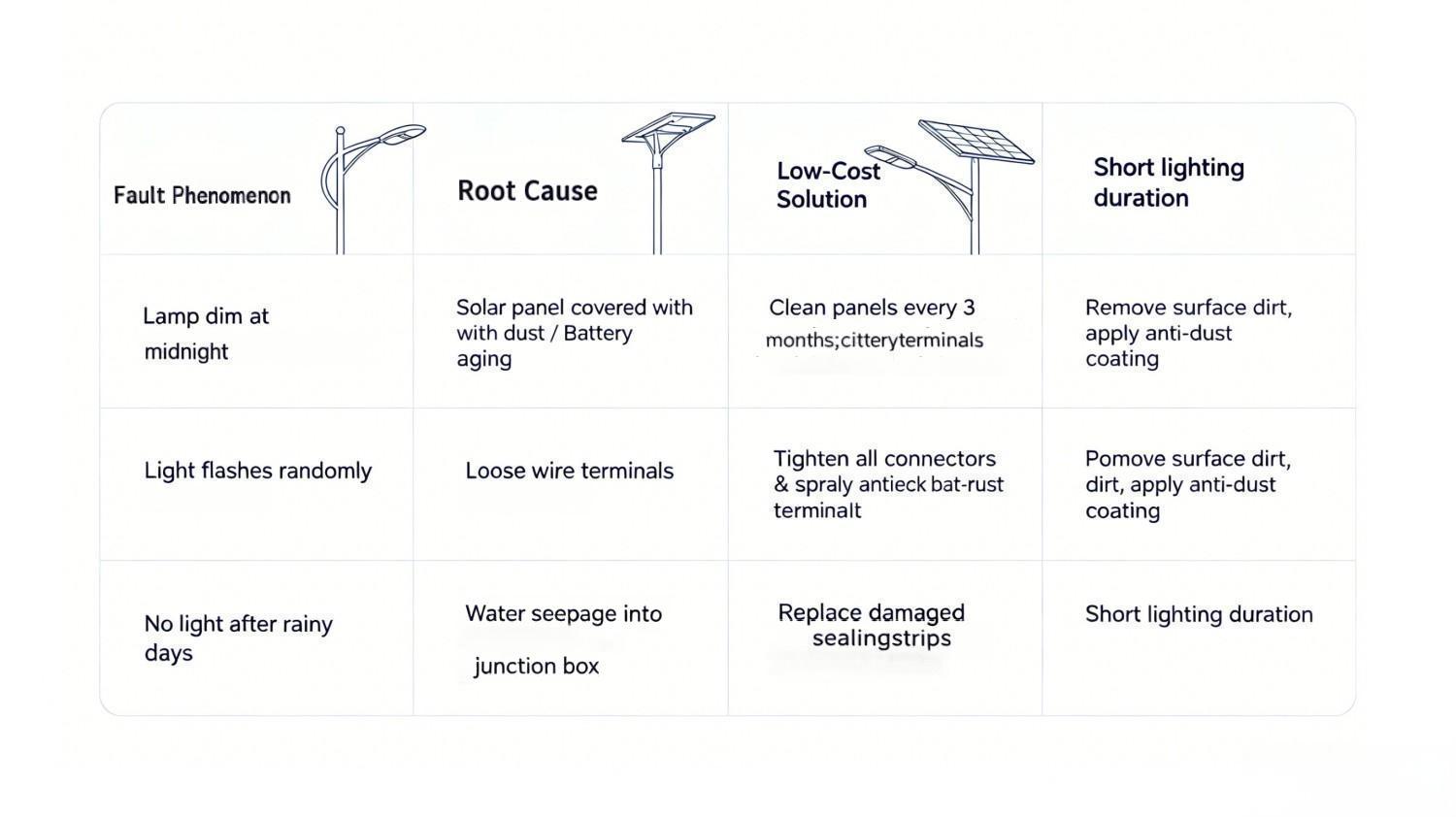
| Fault Phenomenon | Root Cause | Low-Cost Solution |
| Lamp dim at midnight | Solar panel covered with dust / Battery aging | Clean panels every 3 months; check battery terminals |
| Light flashes randomly | Loose wire terminals | Tighten all connectors & spray anti-rust agent |
| No light after rainy days | Water seepage into junction box | Replace damaged sealing strips |
| Short lighting duration | Poor panel charging efficiency | Remove surface dirt, apply anti-dust coating |
FAQ:
Q1: Are solar street lights completely maintenance-free?
English Answer: Definitely no. Even high-quality integrated solar street lights work outdoors all year round. Dust accumulation, rainwater erosion and natural battery aging will gradually reduce power generation and lighting time. Simple regular low-cost maintenance can effectively avoid sudden failures and expensive overall replacement.
Q2: How much maintenance cost can contractors save annually?
English Answer: According to our overseas project practical data, standardized regular maintenance can cut battery replacement cost by more than 30% and reduce after-sales labor maintenance time by 40% every year. For large-scale road projects with 500+ lamps, contractors can save thousands of US dollars in maintenance costs within two years.
Q3: Do maintenance workers need professional electrician certificates?
English Answer: No professional certificates or professional testing tools are required. General on-site construction workers can finish all daily maintenance work by following the step-by-step guide in this blog, no skilled electricians needed.
Q4: Should I clean solar panels more frequently in African and Southeast Asian projects?
English Answer: Yes. These regions feature heavy dust, frequent rain and high humidity. We suggest shortening the cleaning cycle from 3 months to 1-2 months to guarantee stable power generation efficiency all year round.
Q5: Why do solar street lights fail easily after heavy rain?
English Answer: The core reason is water seepage inside lamp housing or junction box, causing short circuit of internal circuits. Timely waterproof inspection within 24 hours after rain can prevent such hidden faults in advance.
Q6: Can I use detergent or alcohol to clean dirty solar panels?
English Answer: Never use any chemical detergent, alcohol or hard cleaning tools. These will damage the anti-reflection coating on solar panels and cause permanent power generation attenuation. Only clean water and soft cotton cloth are allowed.
Q7: What after-sales maintenance support can HRLUX offer for global contractors?
English Answer: HRLUX provides free official English maintenance manuals, sufficient original spare parts (batteries, sealing strips, controllers), and one-to-one remote technical guidance. We support bulk spare parts shipment for overseas solar lighting projects.
Conclusion
For all solar lighting engineering contractors, standardized low-cost maintenance acts as the core method to cut repair expenditure, prolong lamp service cycle and maximize overall project profits. The three core maintenance steps plus auxiliary low-price consumable schemes feature simple operations, low investment and obvious effects, applicable to road lighting projects across all global regions.
Apart from supplying premium integrated solar street lights, HRLUX also provides full-cycle engineering after-sales service, complete spare parts stock and free professional maintenance manuals for partners.
👉 Free Technical Support Inquiry:If you need customized solar lamp tender solutions, bulk spare parts supply or full-set maintenance guidance for municipal projects in Africa and Southeast Asia, share your project size and construction area with our professional engineering team to receive all-round supporting services.
Related Products
Related Cases
Your Reliable Outdoor Lighting Partner
HRLUXSOLAR focuses on mid-to-high-end outdoor lighting with strict quality standards and a rigorous, responsible team. We take quality as the core and professionalism as the foundation to provide stable and durable outdoor lighting products.We specialize in professional services for municipal and commercial engineering projects, delivering customized lighting solutions for smooth project implementation. We support flexible customization, efficient delivery and full-process technical support to meet diverse project demands.Committed to being your trusted outdoor lighting partner, HRLUXSOLAR keeps improving to create better lighting value for your projects.
Need a Dialux simulation for your project? Click here for a free lighting plan.
Introduction
Nowadays, almost all integrated solar street lights are equipped with motion sensors to realize intelligent dimming, greatly extending battery standby time and reducing energy consumption. Two mainstream sensing solutions dominate the market: PIR infrared sensor and microwave radar sensor.Many contractors and municipal buyers only judge products by upfront cost and choose PIR lights. After installation, they face frequent sensing failure, dim road lighting and high annual maintenance costs, especially in coastal foggy towns, frigid mountain areas and tropical regions with year-round morning mist.Our XCPB all-in-one solar street light adopts upgraded microwave radar sensor as standard factory configuration. This guide fully compares the working principle, pros & cons, full lifecycle cost and suitable scenarios of the two sensors. It helps you avoid common project pitfalls and pick the right sensor for your tender.
1.Working Principle of Two Sensors
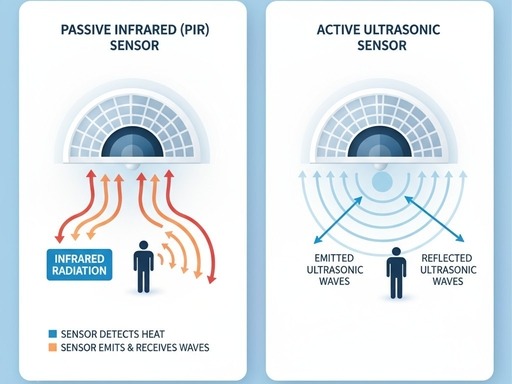
PIR relies on heat detection, while radar works by transmitting and receiving electromagnetic waves
1.1 PIR Infrared Motion Sensor
PIR sensor operates by capturing infrared heat radiation released by humans and vehicles. It triggers brightness changes when detecting temperature differences.It only senses heat sources within a limited fixed angle, and its performance will be blocked by tree leaves, glass, heavy fog and thick dust. Ambient temperature fluctuation directly disturbs normal induction.
1.2 Microwave Radar Sensor
Microwave radar relies on the Doppler effect: it emits low-frequency microwave signals and calculates moving objects via reflected waves, which does not depend on heat temperature at all.It delivers 360° full coverage detection, can penetrate thin obstacles like light fog and sparse branches, and keeps stable operation regardless of external temperature changes.
Our built-in radar modules pass 500h salt spray aging test and -30℃ low-temperature test by third-party laboratory.
2. Core Quantitative Comparison Table
| Comparison Item | PIR Infrared Sensor | Microwave Radar Sensor |
| Max Detection Distance | 4–6 M | 10–12 M |
| Detection Angle | 120° | 360° |
| Fog / Sea Salt Fog Adaptability | Poor performance, prone to false triggering or no induction at all | Excellent, no interference in coastal heavy fog conditions |
| Low Temperature Performance | It tends to fail and respond slowly below 0℃ | Stable operation from -20℃ to +60℃ |
| Anti-blocking Ability | Leaves and thin glass can block the sensor signal. | It can penetrate thin barriers without being affected. |
| Intelligent Dimming Effect | Short sensing distance and frequent flickering of the light | Long sensing distance with smooth brightness switching and no stroboscopic effect |
| Service Life | 3–5 years | 5–8 years, consistent with the overall service life of the lamp |
| Upfront Component Cost | lower | slightly higher |
| Full Lifecycle Project Cost | High (frequent maintenance and replacement) | Low maintenance, no upkeep required for many years |
| Suitable Scenarios | Small courtyard walkway in arid inland areas | rural main roads, coastal towns, parking lots and highways |
3. Advantages & Disadvantages Separately
3.1 PIR Infrared Sensor
Advantages :Low component cost, lowers initial lamp purchase price; Tiny static power consumption under idle state.
Disadvantages :
1.Strongly affected by temperature: high heat in summer and freezing winter both weaken sensing sensitivity;
2.Sea mist, heavy dust and morning fog cause serious sensing failure;
3.Narrow detection angle creates dark blind zones on both sides of roads;
4.Short sensing distance delays lighting activation, pedestrians walk into dark areas before lights brighten;
5.Short service life requires frequent spare part replacement, raising long-term engineering costs.
3.2 Microwave Radar Sensor
Advantages :
1.360° wide-range sensing, no road blind zones;
2.Zero interference from temperature, fog, dust or thin barriers;
3.12m long detection distance lights up roads earlier for pedestrians and vehicles;
4.Stable all-year-round performance cuts later project maintenance labor costs;
5.Perfectly matched with XCPB integrated solar street light’s MPPT control system, boosting rainy-day standby time by 40%;
6.Matched with XCPB die-cast aluminum IP65 housing, dual protection against coastal salt spray and bad weather.
Disadvantages : Higher component cost than ordinary PIR sensors, slightly raising one-time procurement cost.
The radar module only raises single lamp cost by 8–12 USD, which can be offset by saved maintenance fees within 2 years.
4. Full Lifecycle Cost Analysis
Many clients hesitate over radar’s higher upfront price but ignore long-term expenditure differences:
1.PIR solar lights: Sensor fails within 1–2 years. Contractors need to arrange workers to climb poles, buy replacement parts and spend labor fees every year. For large-scale road projects, maintenance expenses accumulate rapidly.
2.XCPB radar solar lights: Radar modules share the same 5–8 year service life as LED and lithium batteries. No frequent repair work needed after installation. Even though the initial unit price is higher, the overall project total cost can be reduced by over 50% within 5 years.
Besides, refitting radar sensors on old split solar lights is not recommended. Separate lamps have mismatched power supply and poor waterproof performance after modification. Our integrated XCPB series integrates radar, controller and battery as one whole unit with factory debugging, achieving optimal matching stability.
5. Recommended Application Scenarios
Choose PIR Infrared Only If :
Small dry inland residential courtyard paths, indoor walkways, short decorative garden lights without fog, frost or heavy traffic.
Must Choose Microwave Radar Sensor (Our XCPB Series) If :
1.Coastal towns with heavy sea salt fog (Vietnam, Philippines, Thailand coastal road projects);
2.High-latitude cold mountain areas with long freezing winters;
3.Main rural roads, factory parking lots, campus perimeter roads with frequent vehicle traffic;
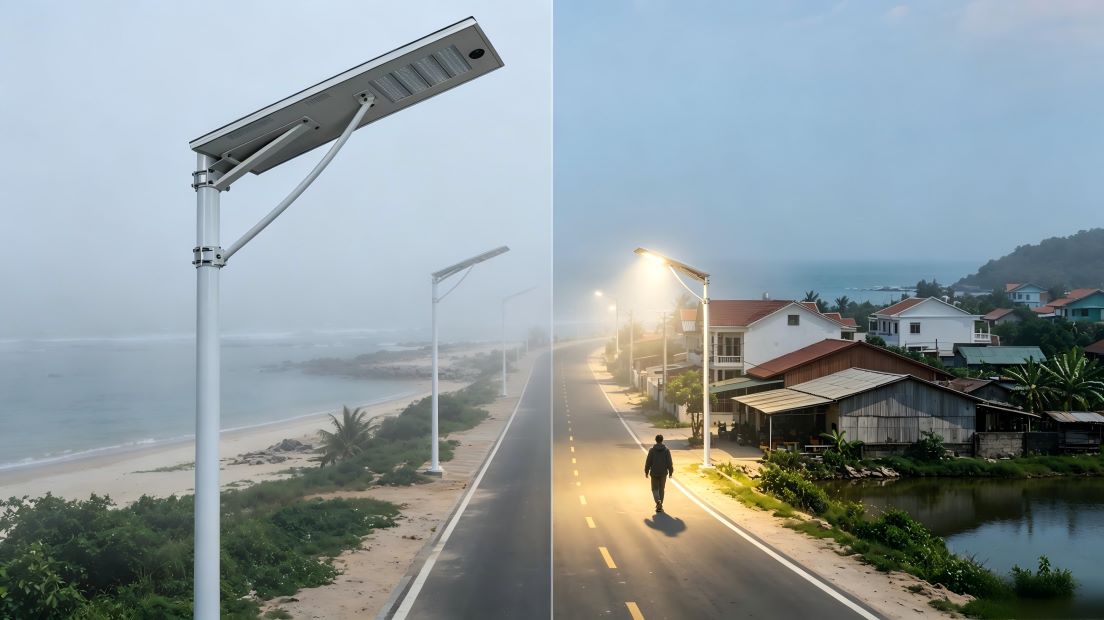
4.Tropical rainy areas with persistent morning fog all year round;
5.Government municipal tender projects requiring long-term stable operation and low maintenance.
6. Common Project Mistakes Caused By Wrong Sensor Selection
Mistake 1: Coastal projects adopt PIR solar lights
Half of the lamps lose sensing function in foggy mornings, leading to dark roads and complaints from local residents.
Mistake 2: Cold mountain areas install PIR lights
Sensors stop working in freezing winter nights; lamps stay dim all night and cannot meet traffic lighting standards.
Mistake 3: Split solar lights retrofitted with radar modules
Poor waterproof sealing after modification leads to water ingress and permanent circuit damage within 1 year.
All these troubles can be completely avoided by selecting our XCPB integrated solar street light with factory-built microwave radar sensor.
7. Real Coastal Project Case
In 2024, a Vietnamese municipal contractor purchased 600 units of 60W XCPB radar solar street lights for a 12km coastal village road reconstruction project.The local area is covered by thick sea fog every morning all year round. After 12 months of continuous operation, zero sensing failure or water corrosion was reported. The client commented that the radar sensor works normally even on foggy days, and the integrated aluminum housing avoids salt damage effectively.This real case fully proves radar sensor’s outstanding adaptability for harsh coastal environments.
Radar sensing test video is available for client reference upon request.
8. Frequently Asked Questions
Q1: Can radar sensor be adjusted to avoid light pollution for residential areas?
Yes. All XCPB radar solar street lights come with remote control to adjust sensing distance, standby dim brightness and lighting duration, effectively reducing light pollution for residential roads.
Q2: Will microwave radar cause signal interference to surrounding equipment?
The lamp uses low-power civilian microwave module, which meets CE & FCC standards and will not interfere with mobile phones, monitoring cameras or roadside equipment.
Q3: Is radar sensor more power-consuming than PIR?
The standby power gap is negligible. The longer sensing distance brings better power-saving logic, and the overall battery power consumption is lower than PIR lamps in actual road operation.
Q4: Can I replace PIR sensor with radar sensor on existing solar lights?
It is not recommended for retrofitting split solar lights. Our integrated XCPB light integrates radar sensor, MPPT controller and battery as a whole, with matched power management system for optimal performance.
Q5: How long is the warranty for your radar sensor?
The built-in microwave radar module enjoys a 5-year factory warranty, same as the LED light source of XCPB series.
Q6: Can radar sensor work normally on mountain roads with many trees?
Yes. Microwave signals can penetrate thin branches without sensing blockage, suitable for mountain forest rural roads.
Q7: Do you supply separate radar sensor spare parts for bulk dealers?
Yes, we provide independent radar sensor spare parts for our cooperative distributors, with stable stock and short delivery cycle.
Related Products
Related Cases
Your Reliable Outdoor Lighting Partner
HRLUXSOLAR focuses on mid-to-high-end outdoor lighting with strict quality standards and a rigorous, responsible team. We take quality as the core and professionalism as the foundation to provide stable and durable outdoor lighting products.We specialize in professional services for municipal and commercial engineering projects, delivering customized lighting solutions for smooth project implementation. We support flexible customization, efficient delivery and full-process technical support to meet diverse project demands.Committed to being your trusted outdoor lighting partner, HRLUXSOLAR keeps improving to create better lighting value for your projects.
Need a Dialux simulation for your project? Click here for a free lighting plan.
Introduction
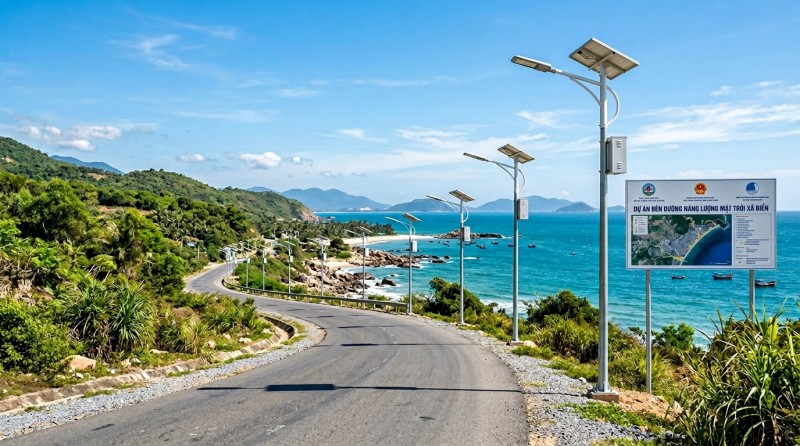
Vietnam’s coastal regions including Da Nang, Hai Phong, Nha Trang, and Vung Tau feature typical tropical marine climates, characterized by long rainy seasons, frequent strong typhoons, high air humidity, and severe salt spray corrosion. Most ordinary solar street lights fail prematurely in these scenarios, suffering from shell rust, circuit corrosion, battery capacity attenuation, and insufficient rainy-day endurance within 1-2 years of operation.
For municipal contractors, rural upgrading projects, and coastal tourism road renovation in Vietnam, selecting standard anti-salt and typhoon-proof all-in-one solar street lights is the core guarantee for long-term stable operation. Based on dozens of successful coastal lighting projects in Vietnam, HRLUXsolar sorts out exclusive parameter standards and purchasing guidelines for local coastal all-in-one solar street lights in 2026, helping buyers avoid low-quality product traps and reduce project after-sales risks.
1.Core Pain Points of Ordinary Solar Lights in Vietnam Coastal Areas
Many project owners choose low-cost generic solar street lights to control upfront costs, resulting in frequent project failures that affect project acceptance and reputation:
•Salt spray corrosion failure: Ordinary spray-painted aluminum shells and common stainless steel accessories are easily oxidized and rusted by sea salt fog, leading to internal water ingress and short circuits.
•Typhoon damage risk: Weak bracket structure and unreasonable installation angle cause lamps to shake violently or even fall off during grade 10-12 typhoons common in Vietnam’s coastal areas.
•High humidity battery decay: Non-encapsulated ordinary batteries are affected by long-term high humidity and high temperature, with capacity dropping sharply during the 4-6 month rainy season.
•Insufficient rainy-day backup: Undersized solar panels and batteries fail to store enough power, resulting in lamp blackout during continuous rainy and cloudy days.
2. 4 Mandatory Configuration Standards for Vietnam Coastal All-In-One Solar Lights
2.1 Marine-Grade Anti-Corrosion Housing & Accessories
Vietnam coastal salt fog lasts for more than 120 days a year, requiring full anti-corrosion configuration. HRLUX coastal customized lamps adopt thickened die-cast aluminum housing with electrostatic marine-grade anti-salt spray coating, passing 500-hour neutral salt spray test. All fixing screws and brackets use 316 stainless steel, completely avoiding rust and oxidation. Compared with ordinary products, the anti-corrosion performance is improved by 60%, adapting to long-term sea breeze and salt spray erosion.
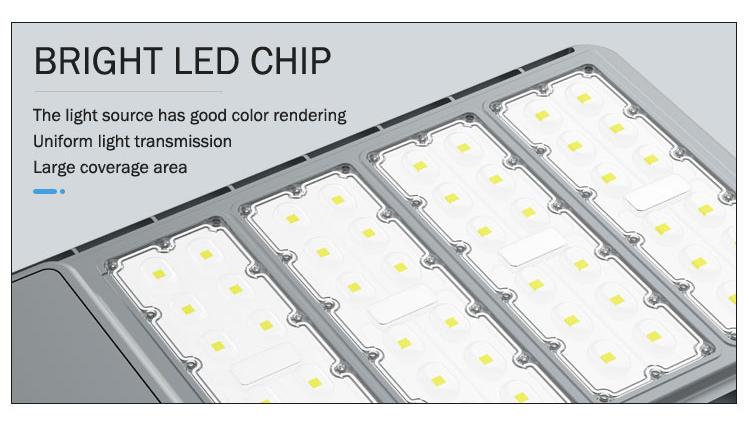
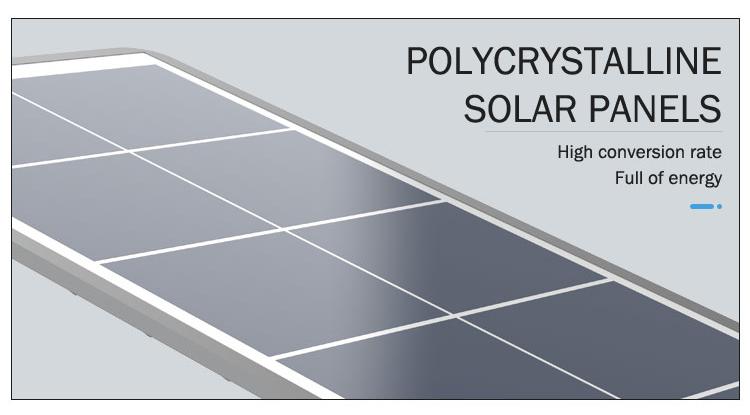
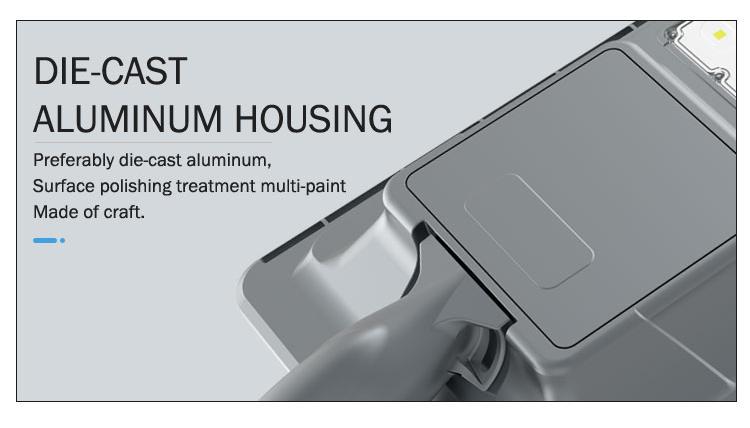
2.2 IP66 Full Sealed Waterproof & Moisture-Proof Design
Vietnam’s annual concentrated rainfall and high air humidity (over 85% RH) put forward strict waterproof requirements. Qualified coastal all-in-one solar street lights must reach IP66 dustproof and waterproof grade, with fully sealed rubber ring design at all shell joints and cable ports. The internal battery and controller adopt full encapsulation and moisture-proof technology to prevent humid air infiltration, ensuring stable operation in long rainy seasons.
2.3 Typhoon-Resistant Reinforced Structure
Frequent typhoons in central and northern Vietnam require enhanced wind resistance. HRLUX coastal dedicated lamps are equipped with thickened reinforced brackets, with optimized installation tilt angle of 18°-22° (adapted to Vietnam’s latitude). The overall structure can resist grade 12 typhoons and 160km/h strong wind, solving the common problems of lamp shaking, loose wiring and falling off in typhoon seasons.
2.4 High-Temp LiFePO4 Battery With Oversized Power Reserve
Vietnam’s coastal temperature ranges from 35℃ to 42℃ in hot seasons, and ordinary lithium batteries are prone to thermal decay. HRLUX adopts customized high-temperature resistant LiFePO4 batteries, stably operating at -30℃ to 65℃, with more than 5000 charge-discharge cycles. Matching oversized monocrystalline solar panels (22% high conversion efficiency), the lamps support 4-6 consecutive rainy days of normal lighting, fully adapting to Vietnam’s long monsoon weather.
3. Professional Lighting Standard & Scene Parameter Recommendation (Dialux Verified)
All matching power, installation height, spacing and illumination standards below are simulated and verified by Dialux lighting software, fully complying with Vietnamese municipal road lighting specifications and coastal project acceptance standards, ensuring uniform illumination and no glare for long-term road operation.
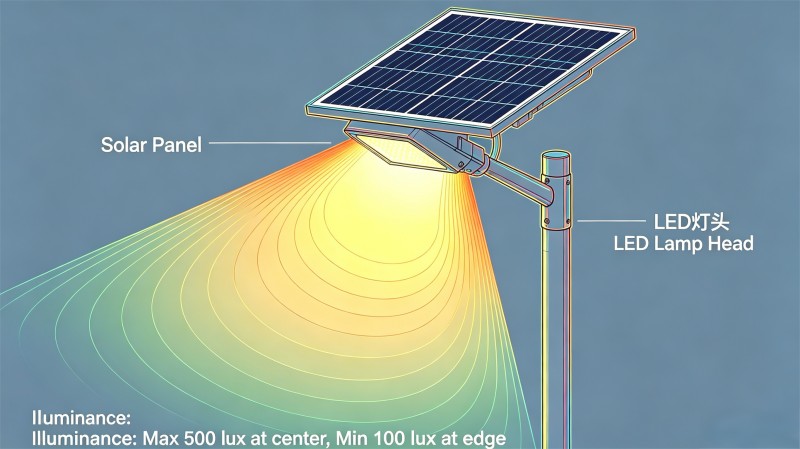
3.1 Parameter Comparison: Ordinary Lamp vs HRLUX Vietnam Coastal Special Lamp
| Performance Item | Ordinary All-in-One Solar Lamp | HRLUX Vietnam Coastal Custom Lamp |
| Shell & Coating | Ordinary spray-painted aluminum, easy rust | Thickened die-cast aluminum + marine-grade anti-salt coating |
| Hardware Accessories | Ordinary stainless steel, easy oxidation | 316 full stainless steel, anti-corrosion |
| Waterproof Grade | IP65, weak moisture resistance | IP66 full sealed, high humidity resistant |
| Wind Resistance Capacity | Grade 8-10 wind resistance | Grade 12 typhoon resistance (160km/h) |
| Battery Type | Ordinary lithium, easy high-temperature decay | High-temp LiFePO4 battery (-30℃~65℃) |
| Rainy Day Backup | 2-3 days, easy blackout | 4-6 days continuous stable lighting |
| Service Life | 3-5 years | 8-10 years |
3.2 Scenario-Based Matching Installation & Illumination Parameters
•Coastal rural village roads: 30W-40W all-in-one lamp, installation height 4-5m, pole spacing 18-22m, average illumination ≥15lux, meeting rural road daily travel needs
•Coastal town main roads: 60W-80W anti-corrosion solar lamp, installation height 6-7m, pole spacing 22-26m, average illumination ≥30lux, uniform brightness for vehicle traffic
•Seaside tourism roads & park lanes: 40W-60W lamp with anti-glare lens, 3000K-4000K warm white light, average illumination 20-25lux, UGR<19, compatible with landscape and pedestrian lighting
4. Real Project Case: Hai Phong Coastal Rural Road Lighting
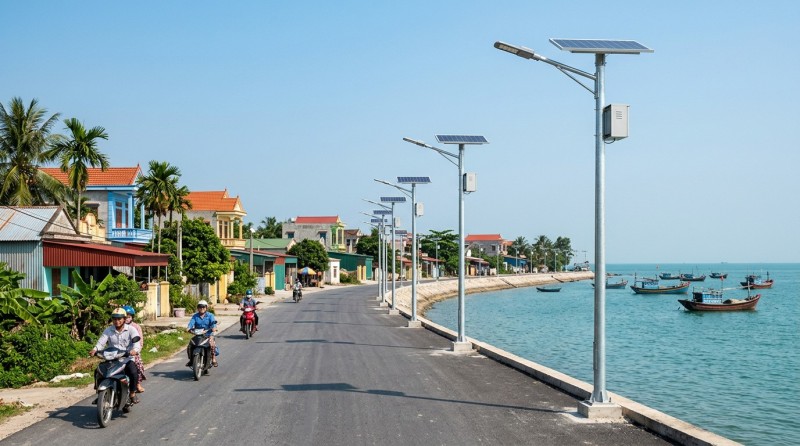
Hai Phong coastal area is affected by perennial salt spray and seasonal typhoons. The local rural road upgrading project adopted 320 sets of HRLUX anti-salt typhoon-proof all-in-one solar street lights. The project was completed in 18 working days with no trenching and wiring required. After 3 years of stable operation, no rust, no lamp failure, and no rainy-day blackout problems occurred, fully meeting local municipal acceptance standards.
5. Frequently Asked Questions
Q1: Can ordinary solar street lights be used in Vietnam coastal areas?
A: Ordinary lamps lack anti-salt spray and typhoon-resistant design, and will suffer from corrosion and damage within 1-2 years. They are not recommended for Vietnam coastal projects.
Q2: How many rainy days can Vietnam coastal solar lights support?
A: HRLUX customized coastal lamps support 4-6 consecutive rainy days of lighting, adapting to Vietnam’s monsoon rainy season.
Q3: What is the service life of anti-corrosion all-in-one solar lights?
A: With standard maintenance, the overall service life can reach 8-10 years, far exceeding ordinary solar lamps.
Q4: Does coastal solar lamp need special daily maintenance?
A: No complex maintenance is required. Simply clean the dust and salt stains on the solar panel every 2-3 months to ensure power generation efficiency, no professional operation is needed.
Q5: Is the 316 stainless steel accessory necessary for coastal lamps?
A: Yes. Ordinary iron and stainless steel accessories will rust and break within 1 year in high-salt fog environments. 316 stainless steel is the mandatory configuration for Vietnam coastal long-term stable operation.
Q6: Can customized wattage and installation parameters be provided for special coastal projects?
A: HRLUX supports full OEM/ODM customization. We can provide exclusive Dialux lighting simulation reports and parameter schemes according to project road width, latitude, and local climate conditions.
Related Products
Related Cases
Your Reliable Outdoor Lighting Partner
HRLUXSOLAR focuses on mid-to-high-end outdoor lighting with strict quality standards and a rigorous, responsible team. We take quality as the core and professionalism as the foundation to provide stable and durable outdoor lighting products.We specialize in professional services for municipal and commercial engineering projects, delivering customized lighting solutions for smooth project implementation. We support flexible customization, efficient delivery and full-process technical support to meet diverse project demands.Committed to being your trusted outdoor lighting partner, HRLUXSOLAR keeps improving to create better lighting value for your projects.
Need a Dialux simulation for your project? Click here for a free lighting plan.